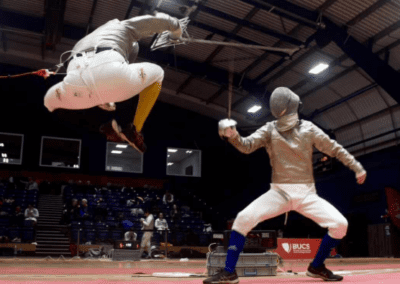
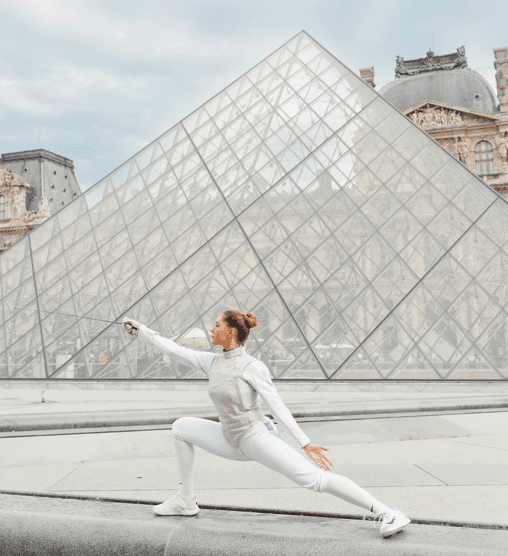
Ligament damage would normally bring competition season to a halt. But, for Ukrainian fencer Svitlana Sopit, it became another obstacle inside a life already shaped by disruption and war.
When Ukrainian fencer Svitlana Sopit suffered an injury just ten days out from the National Championships, she was crushed. But, perspective is everything.
With her home country devastated by ongoing war, Svitlana knew that this injury was a much smaller barrier to overcome than those she and other Ukrainians have faced before.
“I think about people who fight for our country, people who live here and experience this every day, this nightmare,” she says. “I can’t just complain about a little injury. I have to be strong for my country, for my people. At least to show respect.”
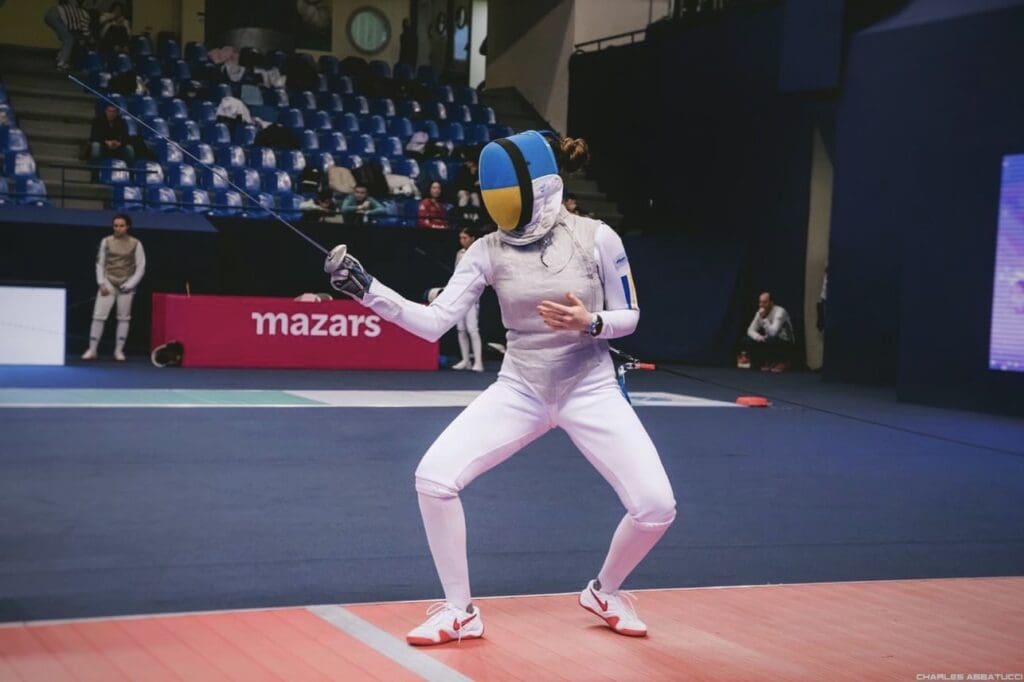
At this moment, Svitlana knew she wasn’t going to let this injury stop her from getting to the competition. For any athlete, wearing your country’s colours holds meaning, but in this case it is even more powerful. She was determined to be there.
“This was something that stressed me the most; not even pain, not even thinking how I’m going to travel with crutches. I was like, ‘no, I have a competition’. I have no option to be out. I just couldn’t miss it.”
What followed was not just a test of pain endurance, but what it means to keep going when the body breaks at exactly the wrong time.
When repetition goes wrong
The injury was sudden – a reminder of how fragile elite sport can be.
“You can do some movements 1000 times before, and then on the 1001st something goes wrong. I did a lunge and I slipped on the fencing piste. It’s my first serious injury,” she says.
At first, she didn’t fully understand the extent of the damage.
“When I tried to get up, I understood that my ankle had no stability, so there must be a problem with the ligaments. You’re never prepared for it.”
An MRI scan two days later confirmed that the ligaments in her ankle were sprained. But the diagnosis quickly became secondary to the reality of the calendar: ten days remained.
“I had to be 110%, and I’m not even close to that,” Svitlana says.
As a member of the Ukrainian national team, the competition carried pressure, especially when European qualification was at stake.
“This is something worth trying, even to come to the competition and stay in the same place. But just do something, just at least go there and try.”
The impact of war on sport
She spent seven days on crutches in the lead up to the competition, and in those days the urgency for travel became more prominent. Living and training in Paris, Svitlana needed to travel back to Ukraine, but even basic travel for a competition can be complex during the current conflict.
“I really had no time to make this decision because with the war now in Ukraine, you can’t travel just by plane,” she says. “You have to spend at least 24 hours just to get to Ukraine. I had all the tickets already, and I decided to go no matter what.”
The war has reshaped every layer of life, including sport. What once would have been routine journeys are now long, fragmented routes across borders.
“It’s been four years that travelling from Ukraine is only possible by train or bus or car. We have to get to the border, the countries that are our neighbours, like Hungary, Romania, Poland, and only then you can take a plane. With our competition destinations, you can imagine it’s a really, really long and exhausting trip.”
It’s not only travel that has been disrupted. The structure of Ukrainian sport itself has changed through the conflict.
“Some coaches left the country, some athletes left the country,” she says. “Also for the male gender, some men can’t leave the country at all. Some can’t train abroad, some have to miss competition. Some guys who left Ukraine can’t come back because it’s dangerous to be mobilised for the armies.”
“Also, with war and the Ministry of Sport, all the resources and financial part goes more to the army, to economics. So, of course, we don’t get much sponsorship.
“I’m really impressed that my sport started to develop under this condition. In Ukraine it’s now more developed during the war than it was before the war. This is a phenomenon that I can’t explain, but it’s really inspiring.”
This resilience runs parallel to her own experience on the fencing piste. Despite injury, she chose to compete, and what followed was not just a test of physical endurance, but mental discipline.
Competition day
“The less mercy I had and the less position of victim I took, it helped me to stay aggressive and more concentrated on my performance, rather than on my injury.”
“It was quite challenging for me by the end because the competition lasts quite long, it’s at least three to five hours. So it was a long day. It was full of pain, but it also made me more hungry for a challenge.”
Against the odds, Svitlana succeeded – qualifying for the European Championships.
The experience has since reshaped how she thinks about injury, recovery, and the longevity of her fencing career. Now prioritising rehabilitation and strengthening exercises.
“They are not optional. It’s the foundation for your athletic longevity. That’s why this was a good lesson for me as well, and a reminder.”
“You can be a great fencer, but just one injury can stop you. Injuries also happen to Olympians, to everybody,” she says.
At 23-years-old, Svitlana is still relatively young in terms of fencing, but her ambitions for the future are long-term, with sights set on the Olympics one day.
“I saw fencing in the Olympics in 2012 in London. I really liked the fencing uniform and I was like, ‘this is what I want’. I knew nothing about it back then but here I am. It’s been 12 years!”
Although LA 2028 may be too soon, the drive for the next is already beginning.
“I’m focused more on the next Olympics, to have better understanding, preparation, and a more stable life because this period was really hard in terms of all the things that are happening in my country. There was not enough stability with training.”
A life without stability
Stability is not something Svitlana can take for granted – neither in sport or life. When the war first began, she witnessed the devastation firsthand.
“When the war started I was in Ukraine and I saw all the events live,” she says. “After that, me and my team, we spent 5 months abroad, just going to different countries because we couldn’t come back. My city was occupied and it was really hard.
“We keep training abroad, without seeing our families, without knowing if we have a place to come back to.”
Eventually, a French club offered Svitlana and her sister a place to train in Paris. It provided a safe and continuous place to develop as an athlete, but it too came with hardships.
“I don’t see my family often. You live a double life, because half of your life is here, half is already abroad. You don’t feel like you are at home anywhere.”
Svitlana is constantly reminded why this is the case.
“On May 24th, we had a massive attack on Ukraine, just 200 metres from my house. There were explosions – it was so loud,” she says.
The situation Svitlana and many other Ukrainian athletes find themselves is a powerful reminder to be resilient through injury, no matter what.
“Don’t take for granted your physical abilities, try to develop them, try to strengthen them, because this is the only way also to educate yourself on becoming stronger and more protected from injuries,” she says. “No matter your goals, no matter how good you are, injuries happen, and you can never be totally prepared for them.”
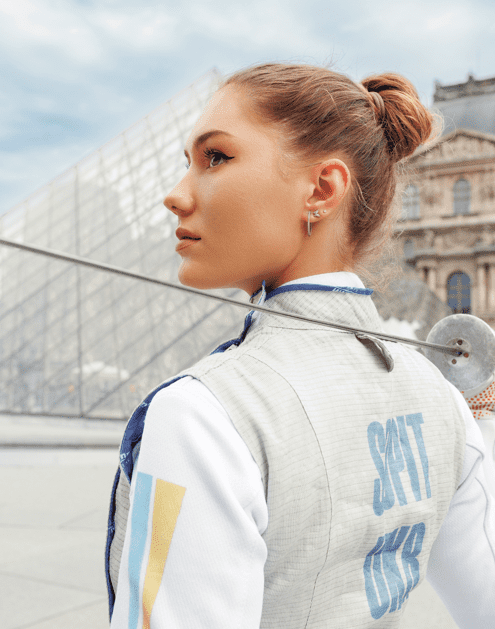
Through sport, Svitlana represents Ukraine with pride. On the fencing piste she wears their colours – blue and yellow – with the hope that one day things will be different.
“In any competition abroad, I scream about Ukraine – don’t forget to pay attention, to follow events, and to support because it’s the least I can do.
“We didn’t choose to live this way.”