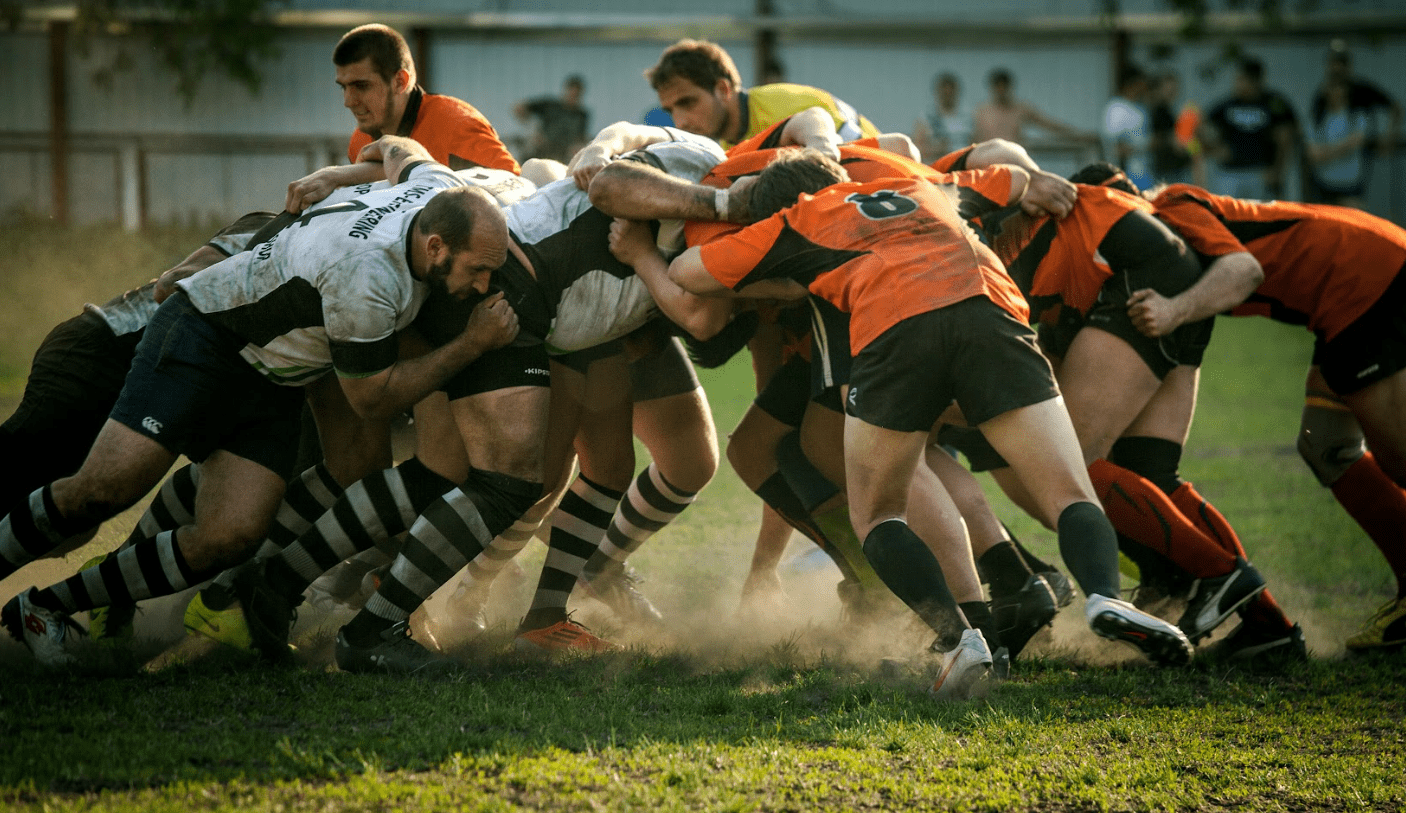
Rugby insists its concussion crisis is under more control than ever. Tackle heights have been lowered and return-to-play protocols have been tightened. But beyond the law changes and press releases, what does ‘safe’ actually look like for the players? Will Mesney finds out more.
The hits you don’t remember
Typically, the conversation surrounding brain injuries in rugby has focused on the dramatic moments: a player knocked unconscious, helped off the pitch, perhaps waving groggily to teammates. But emerging research points to a different culprit entirely.
New studies show that an accumulation of sub-concussions can lead to long term issues, such as Chronic Traumatic Encephalopathy (CTE), a progressive neurodegenerative disease that directly leads to early-onset dementia.
A sub-concussive impact is a blow to the head that causes brain tissue to move or twist, but does not result in a diagnosed concussion.
Former Wales international, Alix Popham, is now the founder of Head for Change, a charity promoting brain health in sport.
“My neurologist estimated I suffered 100,000 sub-concussive hits throughout my career,” he says. “I just wish I was educated properly, I didn’t even know what a sub-concussive hit was when I was playing.”
“Players today still trust the protocols which have been proven they aren’t fit for purpose. There’s a massive cultural change that needs to happen.”
Popham was diagnosed with early onset dementia aged 40, shortly after retiring.
Popham is also part of a group of 560 former players attempting to sue rugby’s governing bodies, who say they ‘failed to inform players of the material risks associated with repeated head trauma.’
“The majority of the research into the effects of repetitive head trauma in rugby is being paid for by World Rugby, WRU, England Rugby,” he says. “If it doesn’t suit their narrative, it often doesn’t get released.”
Distrust regarding concussions between players and rugby’s governing bodies intensified in 2021, following Paul McCrory’s plagiarism scandal. McCrory chaired the Concussion in Sport Group (CISG) for 21 years, which produces consensus statements summarising concussion research.
These statements influence World Rugby’s guidelines, which are used as a baseline across professional and grassroots rugby.
However, McCrory was found to have plagiarised and mis-represented sources in all four of the consensus statements that he was the lead author of. He resigned just hours after.
“It’s truly shocking. McCrory’s got blood on his hands,” Popham says. “I’ve got no idea how he hasn’t gone to prison.”
“I’ve spoken to parents who’ve had kids go back on the pitch too soon after a concussion, and have died as a result of second impact syndrome.”
In the statements McCrory released, he cast doubt on the link between repeated sub-concussions and CTE, a position that is now widely discredited.
World Rugby’s guidelines used to have a mandatory three-week stand-down for concussed players until 2012. It was then changed to a six-day return to play protocol, which brought it in line with the recommendations made by CISG in that year’s consensus paper.
World Rugby changed the return to play protocol to the current 12 days in 2021, which Popham argues is still far too short.
“When there is a KO, a player scientifically isn’t safe to play again for 28 days. There are far too many loopholes that a player or a team can go through to get a player back quicker.”
Alan Gilpin, the CEO of World Rugby says, “We want people to feel comfortable that we have got a game that is safe to play at all levels. We will keep advancing with science available as quickly as possible.”
Barney Davies, who used to be the captain of Super Bucs side Leeds Beckett University, had to retire at the age of 23 due to concussive symptoms he built up in his career.
Davies now runs the Instagram page called @the_concussion_journey, documenting his experiences whilst supporting others with post-concussion syndrome.
“I’ve experienced concussion after concussion throughout my career,” he says. “It killed my brain cells and has taken years to recover.
“After retiring, I had every symptom you could have – amnesia, insomnia, panic attacks, everything.”
Davies, who played as a centre weighing 105 kilograms, routinely made 15 tackles and carries per game.
This is not out of the ordinary for a centre, as they are at the forefront of both a team’s attack by carrying the ball into the attack, but are also responsible for putting in big tackles in defence.
The all-action nature of the position naturally put Davies at a very high risk of head contact with opposing players.
This creates a troubling paradox for the game, as the generation of players who the research is being conducted on were arguably playing a completely different game.
When asked if rugby had a cultural issue surrounding head injuries, Davies says, “It’s just a complete lack of education and old school mentality. You’ve got coaches in charge of rugby at schools or clubs across the country who likely played in the 80’s or 90’s.
“Back then, there were fewer carries per game, and everyone weighed less. The forces in the game they were playing are unrecognisable compared to today.
“I had 20 concussions before the age of 23, it’s a different game. In their minds there is no problem at all. When I was told to ‘man up’ or ‘get on with it,’ I just thought why? I’m putting my body through so much more than you ever used to. “
Unfortunately, the repeated head trauma modern rugby players endure can have tragic consequences. New Zealand team-mates Billy Guyton and Shane Christie both took their own lives due to struggles they had linked with the effects of continual sub-concussions they sustained throughout their careers.
Despite retiring when he was 32, the mere act of running brought on severe headaches for Christie. His professional career ended quickly, having secured his first contract aged 28.
However, Christie’s low energy, mood swings and paranoia continued in his retirement. He took his life last August.
On a New Zealand rugby podcast, What A Lad, Christie’s former partner Holly spoke of what it was like to be with a man dealing with a severe brain injury.
This anecdote offered a bleak reality that is now a common refrain: the game that Christie and Guyton loved, did not serve them well.
So, how does rugby recover?
For all the law changes, promises and protocols, the question is no longer whether rugby is changing, rather is it reacting to the changes it’s undergoing quickly enough.
Until there is greater clarity around the effects of repeated head trauma, rugby’s claims about player welfare remain difficult to justify.
It seems what has made the sport lag behind the science available is the macho culture of rugby, which has been detrimental to the brain health of players.
That outdated mindset still shapes decision-making in schools and clubs, where players are encouraged to prioritise the team over their own safety.
Yet even with better research and stricter protocols, there is an uncomfortable reality at the heart of the sport. Rugby’s defining characteristic, its physicality, is also its greatest risk. Reducing head contact without fundamentally altering the nature of the game presents a challenge with no easy solution.
For former players like Popham and Davies, the damage has already been done. Rugby’s recovery may ultimately depend on whether it’s willing to confront that reality not just in policy, but in practice.