Beneath the speed and precision in fencing lies a battle of focus and deception, where the real weapon is the mind.
Fencing is a sport met with mixed reactions: often excitement at the prospect of some good old-fashioned swashbuckling, or the more joking comparison of the kit to beekeeping suits.
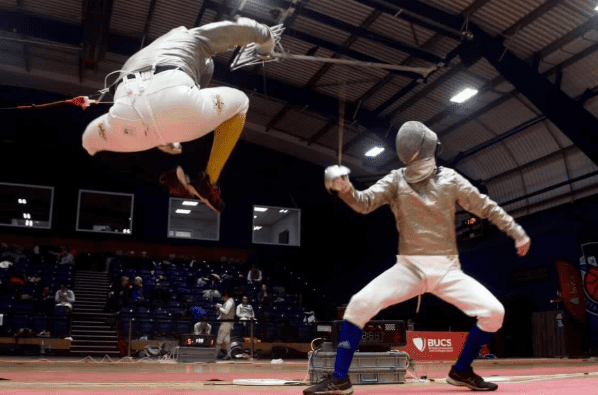
What most people haven’t heard, is that the tip of a fencing blade is widely said to be the second fastest moving object in sport, after only a bullet.
The athleticism, strategy, precision, and speed that it takes to get to the top is not to be taken lightly. Described in the Olympics as ‘physical chess’, fencing requires brilliant mental dexterity and instant recovery.
After all, if you can’t keep your cool when someone’s running at you with a sword, how do you expect to win?
Talking to the experts
Adam Blight, coach at Sheffield Buccaneers Fencing Club, has been fencing since 1978. Blight knows the game like few others, having produced multiple National Champions, and even a 2012 Olympian. He also knows exactly how crucial it is to understand the mind games.
“If you aren’t ready to play the game at that level, you’ll find that your opponents will be. It’s very psychological,” he says.
So, you’re on the piste, sword in hand. The referee says ‘allez’ (‘go’) – but your opponent doesn’t move. You hesitate and begin to doubt if you heard correctly, glancing at the ref to be sure. In that split second, your opponent strikes. You lose the point and, with it, the certainty of your win.
“Take a break, stop and tie your shoelace – just collect yourself,” Blight would say.
Sam Blair, 23, foilist for Team GB and ranked in the top 40 men, finds himself agreeing with this sentiment.
“Try to do one point at a time and have an effective reset in between points. Deep breaths, and delay the time before you go back on,” Blair says.
‘Psych-outs’ can come in all shapes and sizes. Sometimes an opponent will yell with every point, sometimes they might pull an unexpected, intimidating move to throw-off their competition, and sometimes all they need to knock someone’s confidence is the power of a well-known name. Therefore, the ability to reset and recover during a match is perhaps the most crucial skill in fencing.
However, before people can understand the psychology, they must understand the sport.
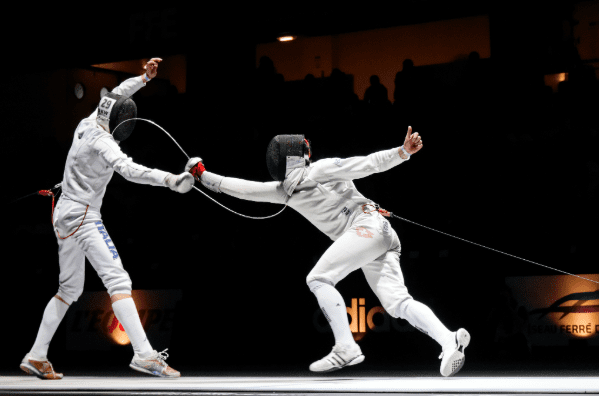
A fencing overview
There are three types of swords in fencing, each with their own target areas and rules: foil, epee, and sabre. This article focuses on foil specifically, but the mental sparring is equally applicable to every other blade, not to mention the majority of one-on-one sports.
Obviously, the aim is to score the most points against the opponent – there is no such thing as a draw in fencing.
In foil (and sabre), this is made more complicated by the rules of priority, which essentially denotes positions that fighters can and can’t be in to score ‘touches’. If they don’t have priority, they don’t have the point. Therefore, a lot of the game is in coaxing the opponent into a position where they lose their priority.
“It’s a mental game of how can I be in charge of what’s going on and force them to react to my moves,” Blair says. “It’s fencing your match, not their match. Be more proactive than reactive.”
Blight speaks more about the intricacies of the game: “You’ve got to think of a fencing bout as involving three people – two fencers, and the referee. And the referee is just as susceptible to mind games.”
Indeed, since the 2024 Paris Olympics, the Italians developed a reputation for their on-piste appeals to the referees, often making their displeasure of certain decisions very evident. This forces the referee to pay more attention to their movements during the match, whilst simultaneously resulting in the ref becoming more hesitant to make a decision against them, unless they’re entirely confident.
The Italians aren’t the only ones to play this game; Blair has his own tactic with the referees.
“If the ref says to go back, sometimes I’ll stay still, looking at them, and take my time about it,” he says.“I never, ever, let myself look like I’m going to lose.”
This technique is a subtle way of displaying dominance on the piste, both to the referee, and to the opponent. In this sport, dominance means priority – even when on the defence.
All in the mind
Even accomplished foilist Blair isn’t immune to getting ‘psyched-out’.
“I lost to someone in my last year of juniors and it prevented me from going to an international competition,” he says.
“He was shouting a lot, and all I could think was, ‘why am I losing to you?’. I wasn’t thinking about fencing at all. I still think about it now.”
This highlights the importance of speedy recovery in fencing. So speedy, in fact, that athletes must recover whilst still within the match. Failure to do so almost always results in a loss, no matter the level of their training.
Blair mentioned that he particularly struggled with opponents who cheer excessively, and that it can make him ‘lose his head’, especially when fighting someone whom he would usually expect to beat.
“I always do better against better people. If I’m fencing someone I perceive to be worse than me, I feel like mind games come into it more.
“If you recognise that they’re better than you, you’re thinking about how to improve. If you think that they’re worse than you, you blame yourself for your mistakes.”
Stepping into the competition
The games begin the moment a fencer steps into the competition hall – potential opponents are sizing each other up, and many will already be growing nervous of people they perceive to be particularly experienced.
“As you walk around the competition, be confident, and display confidence,” Blight says.
“Fencers should have an on-piste persona. I try to have an obvious persona that gets under my opponent’s skin a little bit.”
This technique not only helps to unsettle other competitors, but also leans into the expression of ‘fake it ‘til you make it’; even artificial self-assurance can have a significant impact on a fencer’s calmness and confidence going into a match.
“You want them to feel like they’re not enjoying the bout. If it’s not a pleasant experience for them, they underperform in all sorts of ways,” he says.
An opponent certainly won’t enjoy a match if everything is designed to test their patience.
Fencing is often referred to as a niche sport but, with over 10 million fencers worldwide, it’s in the Olympics for a reason.
The game of ‘physical chess’ requires immense athleticism, refined mental dexterity, and the very important ability to properly wind people up.
Do you think you could hold your own in a sword fight?