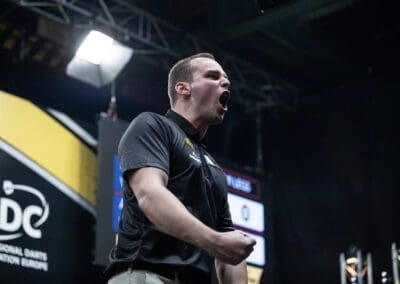
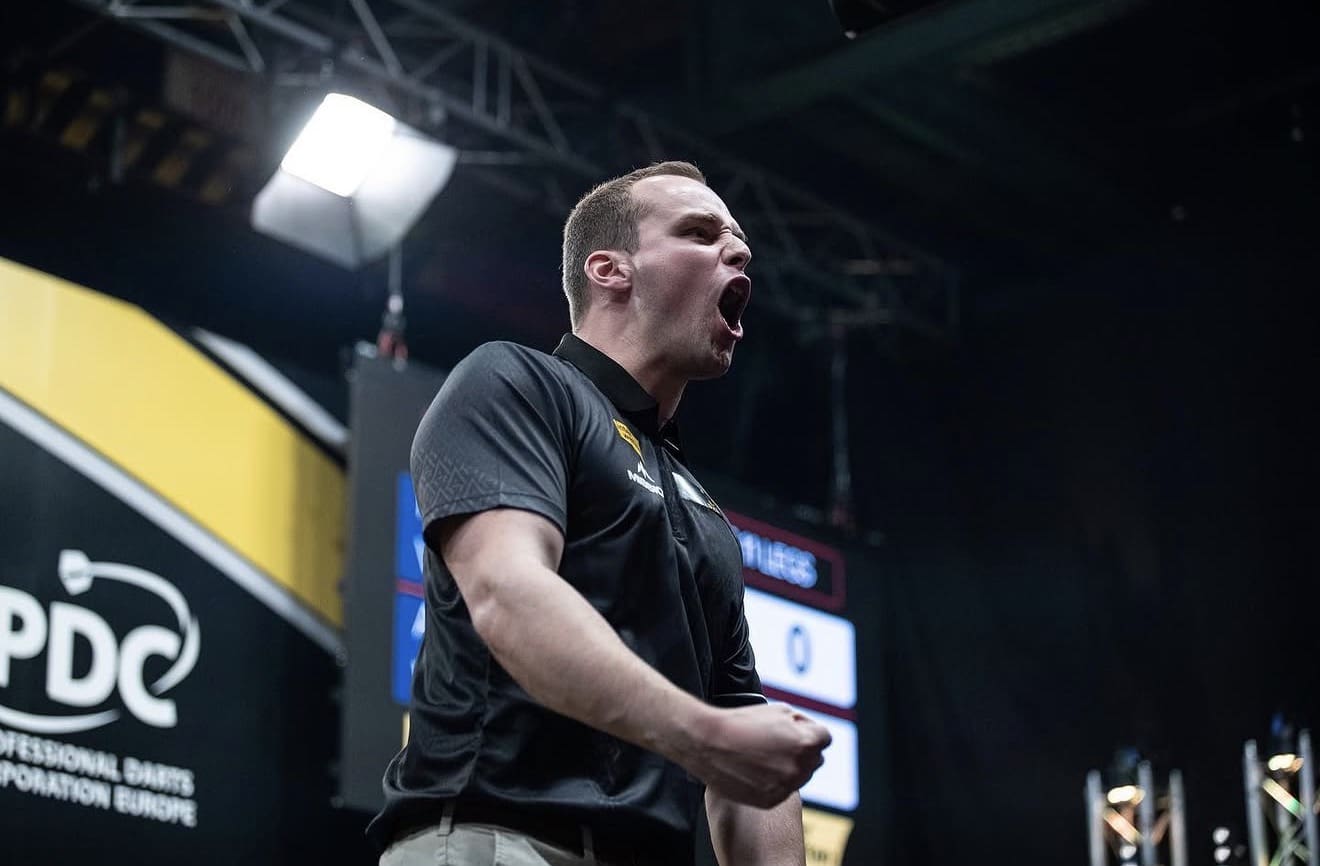
One week Adam Warner was a professional darts player. The next, he was back at Q-School fighting to earn his place again. In this Back in Action feature, Warner opens up about pressure, professional identity and the psychological resilience required to prove he still belonged on the PDC circuit.
At Q-School, careers can disappear quickly.
There are no roaring crowds or dramatic walk-ons. Just rows of dartboards in a line and hundreds of players battling it out to win a place on the Professional Darts Circuit. Some are chasing the dream for the first time and others are trying to reclaim something they once had.
For Adam Warner, Q-School 2024 was not simply another tournament on the calendar. It was a fight to get his professional status back.
After losing his PDC Tour Card at the end of the previous year, Warner found himself in a position that many professional athletes will never prepare for: One week, you are competing on the professional tour. The next, you are trying to prove you still belong there. Losing your professional status will fracture confidence and self-belief just as deeply as any physical injury.
The challenge was not simply to ‘throw better’, it was rebuilding mentally after the disappointment of losing the card he had worked so hard to earn in the first place. The pressure of Q-School only intensified that reality. In a room filled with players all chasing the same outcome, there is little space to dwell on doubt.
Beneath the averages and scorelines are athletes navigating the fear and uncertainty of confidence in professional sport.
Losing the card wasn’t the shock
For many athletes, losing professional status can feel like the collapse of identity. In darts, where careers are often judged through rankings, averages and the possession of a Tour Card, it would be easy to assume that falling outside the PDC’s top 64 would trigger panic. But for Warner, the experience with a level of realism challenged the typical comeback narrative.
“Losing my Tour Card was something I’d been expecting for a long time before it happened,” he says. “I’d not been good enough for the top 64 over the two years but I had improved considerably in the last six months.”
Rather than treating the loss as a devastating blow, Warner viewed it as an honest reflection of where his game stood at the time. That acceptance became important. Instead of forcing drastic changes or spiralling into frustration, he focused on the progress he had already begun making towards the end of his two-year spell on tour.
“This gave me the confidence to have another go at Q-School,” he says. “My routine and mindset didn’t change. I still played a lot of local open tournaments over the Christmas period to ensure my game was in the best possible place come Q-School.”
This confidence and sense of stubbornness when it comes to preparation is perhaps what makes Warner’s story different from many athletes navigating setbacks. While the outside perception of this loss of professional status may suggest failure, he never viewed the situation as career-ending. His understanding of professional darts extends beyond the narrow definition many fans attach to the PDC circuit.
“I’d definitely say that being a darts player was, and still is a big part of my identity,” he says. “But I wouldn’t say being a Tour Card holder was. Of course, I’d have preferred to have a Tour Card than now, but I didn’t feel that not having one would have been a devastating blow,” he says.
In many ways, that mindset became Warner’s greatest strength. While others may have viewed Q-School as a desperate final opportunity, he approached it with perspective and a growing belief in his own game. Having already won his card through Q-School two years prior, he trusted the process that had already begun.
Winning back belief
For many players, Q-School is defined by pressure, particularly as a retuner. Careers can be shaped or ended over the course of a few matches, with every missed dart carrying consequence. But while the atmosphere in the room can feel unforgiving, Warner never viewed the experience through fear.
“I don’t think I felt extra pressure,” he says. “It felt like more of an advantage. I knew I’d got through Q-School before and a lot of the opposition had to play a three day first stage which I was exempt from. I was also fairly comfortable with the idea of not winning a Tour Card back and I think all these things combined helped me greatly.”
The improvements he had seen towards the end of his first spell on tour had convinced him he belonged at that level, and that belief only strengthened as the week progressed.
Still, the pressure of the final day remained unavoidable.
“I was very happy to win it back, especially having gone into the fourth day knowing I needed to win at least three matches.”
Unlike standard ranking tournaments, Q-School is a gruelling multi-day qualifying event where players compete for a limited number of PDC Tour Cards. Across the week, points are awarded based on how far players progress each day, with consistent performances often proving just as important as individual standout runs. For those who do not automatically qualify through reaching a final or winning an event, every match becomes crucial in the race to climb the order of merit and secure one of the cards available.
As the tournament reached the decisive stage, every game added significance. One of those matches came against fellow former Tour Card holder Jason Heaver, in what Warner describes as a ‘high quality game’, the kind of performance that meant more than simply advancing through the draw.
“That strong performance, along with the strong end to my first two-year stint, gave me the belief that I could compete at the professional level,” Warner says.
What ‘professional’ really means
For all the pressure surrounding the event, Warner is also keen to challenge the way many people view life on the PDC circuit.
“I think the main misunderstanding people have is of the term ‘professional,’” he says. “To me, professional means it is your job and sole income. For around a third of the 128 Tour Card holders this isn’t the case. Either out of preference or necessity.”
It is a perspective that highlights the often overlooked reality of professional darts beneath the televised stages and packed arenas. Outside the sport’s elite names exists a large group of players constantly trying to establish themselves, balancing pressure, travel and uncertainty in pursuit of progression.
Warner also believes the structure of the sport means a card alone does not always reflect the true standard of a player.
“I’d say the 128 aren’t necessarily the 128 best players in the world. The bottom 64 especially are just players who have the opportunity to try and break into the top 64.”
“Yes, you have won a gruelling week of competition to get there,” he says, “but it doesn’t mean you’re better or worse than a lot of other players who maybe didn’t make it through.”
Perhaps that honesty is what makes Warner’s story so compelling. His return to the PDC was never framed through desperation or dramatic redemption. Instead, it was built on realism, consistency and belief in gradual improvement. In a sporting culture often obsessed with collapse and comeback, his recovery offers a quieter form of resilience – one grounded not in emotion, but in perspective.