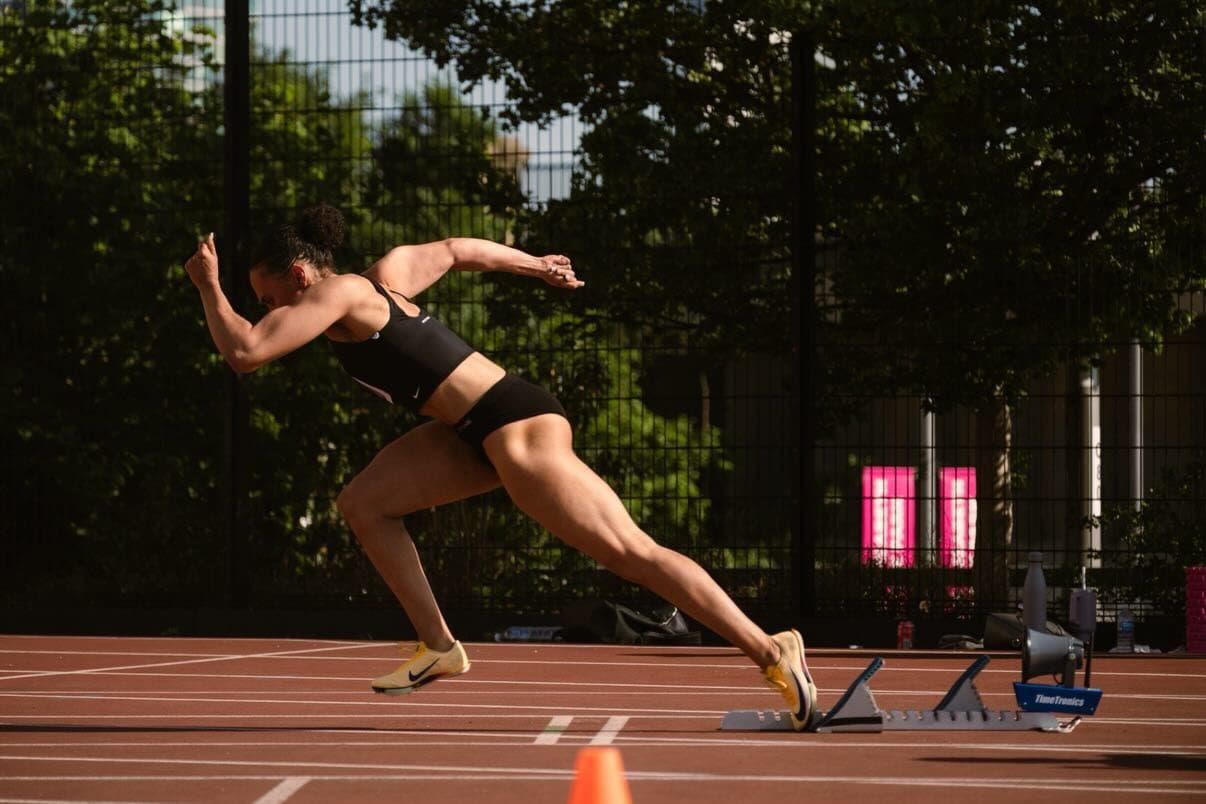
At 12, Monae Winston-Westfield was ranked number one in the UK and faster than Dina Asher-Smith. By 15, she was medalling at nationals. Then she vanished. What followed were seven years of illness, grief, and abuse. She threw away her spikes and told herself she was never coming back. This is the story of how she did.
It had been seven years since Monae Winston-Westfield had been findable. No social media. A changed number. A life lived deliberately out of reach.
To the people who had known her as one of the most promising young sprinters in the country – ranked number one in the UK at 12, faster than Dina Asher-Smith at the same age – she had simply vanished. No explanation. No goodbye. Just gone.
Her mum answered the door first. Then she closed it.
It was the summer of 2023, and standing on the other side was Kristal, an old training partner, an old friend, someone Winston-Westfield hadn’t seen in seven years. Someone who had flown in from Florida, shown up unannounced, and knocked on a door she had no guarantee would open.
Winston-Westfield heard her mum call up the stairs. She didn’t move.
“Kristal? Who’s Kristal? I don’t know who Kristal is. I don’t have a friend called Kristal.”
Then it landed.
“She’s in America. I was like, ‘how are you here? What is going on? Oh my God, you came to my house?’”
She ran downstairs.
Kristal was racing the next day at Newham, and she wanted Winston-Westfield there. Like the old days, she said.
Without thinking, Winston-Westfield said yes.
She didn’t know it yet, but she had just said yes to a great deal more than a day out.
Where it all started
Winston-Westfield’s athletics journey began in primary school, as many do, with a teacher and a hunch.
“The teachers saw my dad in a Jamaica top, and obviously because Jamaicans are known to be fast, they were like, ‘Oh my god you’re Jamaican, you must be so fast.’”
The assumption was clumsy. The instinct, it turned out, was right.
She began competing in school races, then the London Youth Games, winning a division with much older competitors. She was scouted by Herne Hill Harriers shortly after. By the time she was 12, the results were difficult to argue with.
“When I was 12, I was ranked number one in the UK for the 200m, and I was eighth all-time.
“I ran faster than Dina Asher-Smith at that age. I was like, ‘okay, I must be quick’. I have to be quick.
“From there I was like, ‘Okay I think I’m gonna do this; this is making sense.’”
She quickly reached local fame, her success plastered across the newspapers.
“They’re all on my wall right now,” she says, smiling.
For the next few years, she was flying. And then 2017 came. She was 15, and running fast.
National medals. Regional medals. South of England. London Schools. Surrey. She medalled everything that year: 60m, 100m, 200m, competing at a level that made the number one ranking at 12 look like a prologue rather than a peak. The newspapers that lined her wall were getting harder to keep up with.
But something was wrong.
She had changed coach at 14, and the environment that came with it was beginning to cost her more than she could afford. Weekly hospital visits. Constant illness. A relationship with the person guiding her career that had curdled into something she couldn’t train her way out of.
“That was like the start of the end of that chapter. It was quite a toxic environment. I was really sick, I was always in hospital,” she says.
But she was, almost cruelly, still winning. Her results held up whilst the foundations beneath crumbled.
“I medalled everything that season. But at the end of the year, for my coach and I, it just wasn’t happening.”
Navigating loss
Idris was her constant.
He had been around since her Herne Hill days – a training partner, a mentor, her ‘track dad’. Where her coach relationship had fractured, Idris held. He watched her. He drove her to hospital appointments. He saw, before she fully admitted it to herself, that she was declining. And eventually, he told her what she needed to hear.
Leave.
So she did. She trained with him briefly, then moved to another coach.
She was finding her footing again, slowly, when Idris passed away.
“When Idris passed away I was like, ‘I’m done, there’s nothing left for me here, this is the only person that was really keeping me in the sport.’
“I wasn’t happy. Yeah, I just wasn’t happy,” she says.
So she quit. For seven years.
It was a complete detox from the sport.
“I didn’t do track, didn’t run, I didn’t do anything, anything track related, anything sport related, didn’t go to the gym, nothing.”
A life away from the track
At first, the break gave her the space she’d been after. Then it didn’t.
“It was just a really bad relationship that ended with police involvement,” she says.
She disappeared from social media; she changed her number; she became clinically underweight.
The Monae that people knew from just a few years before had vanished.
In March 2023, she left.
She travelled the world: Costa Rica, Amsterdam, Spain, Ecuador, Texas. She learnt about herself outside of survival mode.
And then, in July, Kristal showed up at her house.
“She came to me and was like, ‘Where have you been? You just disappeared off the face of the earth! Are you okay?’”
Winston-Westfield updated Kristal on everything, assuring her she was okay. Kristal said she was racing the next day and soon Winston-Westfield had agreed to come along.
“I said I’d come watch her. That’s what we used to do back in the day,” she says.
At the meet, memories came flooding back. Everywhere she turned, Winston-Westfield was seeing people from her past – training partners, coaches, friends.
She bumped into Oje, an old friend she used to train with.
“I was like, ‘Oh my God, like, Oje, you’re here, how are you?!’”
They talked like no time had passed, and soon she was being asked along to training.
“Just come back for one session, if you don’t like it, you don’t have to run again,” he’d said.
Winston-Westfield said that at that point she didn’t miss the track at all. She didn’t want to come back, but agreed because she loved being around her old friends.
And ultimately that was what drew her back in. Restarted her career.
“I thought, ‘I get to hang out with you guys, it’ll be fun.’”
She had no idea what she was walking into.
At first the return to track was traumatic. It brought back memories. Of past coaches, bad sessions, but most of all, of Idris.
“I had to process a lot of things, but then eventually, I started to enjoy it,” she says.
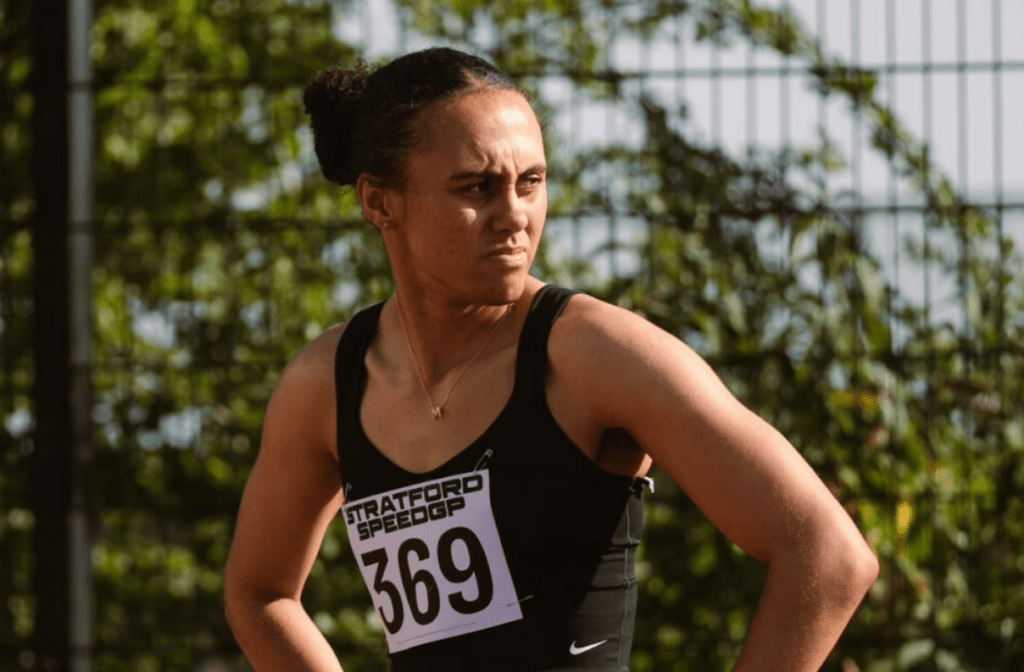
A difficult comeback
Winston-Westfield’s comeback story isn’t as simple as that though. Just as her love for the sport had been rekindled, her body fought against it.
Injury after injury: cracked spine, pulled adductor, fractured ankle, sprained the other ankle.
At first she ran through the setbacks, enduring the pain. At Surrey, her first race back, she got bronze.
But eventually the spine injury forced her out of action.
“One doctor was like, you’re never going to run again; this is going to affect you for the rest of your life. I was like, okay, that sounds a bit dramatic,” Winston-Westfield says.
But time out has its own weight. She considered quitting for good.
“The sport’s not fun when you’re injured. So I was like, ‘what am I doing this for?’
“I feel like I’ve already missed so much time. I don’t have another year to waste.”
She spoke with a sports psychologist, and started to work through her situation.
That helped, along with her friends, and how quickly she’d been running. It all kept her in.
“I thought, ‘I’ve already come back and run the same times I did when I was younger, so if I just stay at it, I can run faster.’”
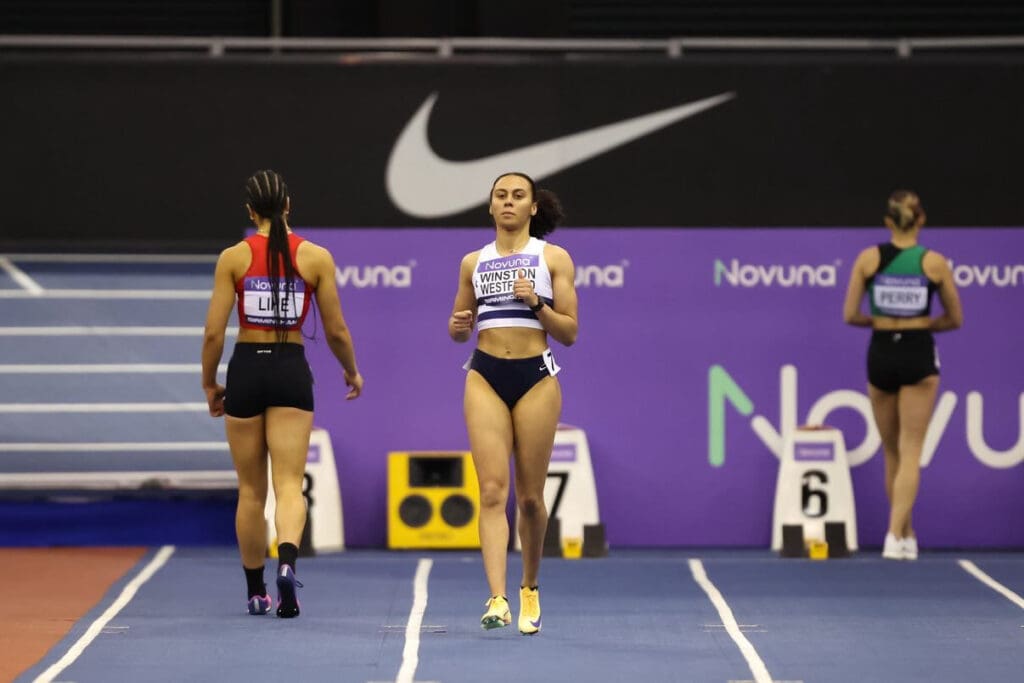
She saw her injury through, eventually returning to training. This season, she ran a sub-25 200m for the first time. And then a sub-24.
“Every race I’m PB’ing, every race I’m getting better,” she says.
“It’s been a lot of first experiences; I’m running the times I was promised to run when I was in the sport before.”
She’s qualified for the British Championships for the first time.
“I think a lot of people kind of expected me to be fast, but they expected it to be harder.”
Winston-Westfield credits her recent success to her mindset.
“A happy athlete is a good athlete. A happy athlete is a fast athlete.”
Her attitude around the sport now is almost unrecognisable from that of her younger years. She balances training with a job at a ceramics studio, a quiet contrast to the track.
“I think if I’d stayed in the sport all those years, I would’ve got to the age I am now and have nothing else to give.”
Her body has shifted. Her mind is stronger. Her circle is healthier. And her love for the sport is real again.
Her newspapers are still on her wall.
“As of right now… I don’t want to jinx anything… but I’m injury-free.
“I think I’m 20th in the UK right now.”
Her relationship with the sport now?
“The best that it’s been ever.”