
Greg Butler watched Adam Peaty & Mel Marshall rewrite the history books from inside the same squad. After years of setbacks, missed Olympic targets and funding uncertainty, the double British champion is now making waves in his own right.
For Great Britain breaststroker Greg Butler, the path to elite swimming was written in the stars.
It is a sport dictated by the relentless ticking of the clock and the grueling reality of twenty plus hours spent in the water every week, supplemented by gym work, physio, and of course – recovery.
At 25 years old, the GB swimmer has experienced the absolute highs of British titles, alongside the crushing, emotionally draining lows of missed Olympic targets and funding cuts. Yet, in an environment where a hundredth of a second can alter the course of a career, Butler has learned that the ultimate recovery is often mental.
Transitioning from a dominant junior career into the unforgiving senior ranks at Loughborough University provided the first major test of his resilience.
“I was at Derby with Mel Marshall initially, and then Mandy Bell and I was doing all right,” he says. “I think I was 17 or 18 when I went to European juniors, and then right after European juniors I broke the 100m English record.”
“It was a really fast swim and then Mel had gone over to Loughborough with the GB base and I’d worked with Mel and Adam [Peaty] – who was the best in the world by miles. So then off the back of that English record, I thought I can go further with this. I was confirmed for a place in the center and then kind of just made that transition.”
“Alongside the transition of training you’re moving from a junior swimmer to a senior swimmer which is completely different and that was really hard. Going from being the top dog at junior, and then for me it was such a big plateau and so many years of just really not moving on. Tons of setbacks. It’s a tough one,” Butler says.
A massive part of that transition involved managing an intense training load alongside external expectations and university life, where every performance carries an added weight.
“And adjusting to the new environment; I was at uni now, it’s different kinds of training I was adjusting to. I guess one of the other things which made it more of a struggle was I was receiving funding and there’s that external pressure to perform now because you’re getting paid to swim. So that was another thing on top of it I’d say which was maybe more of a stress.”
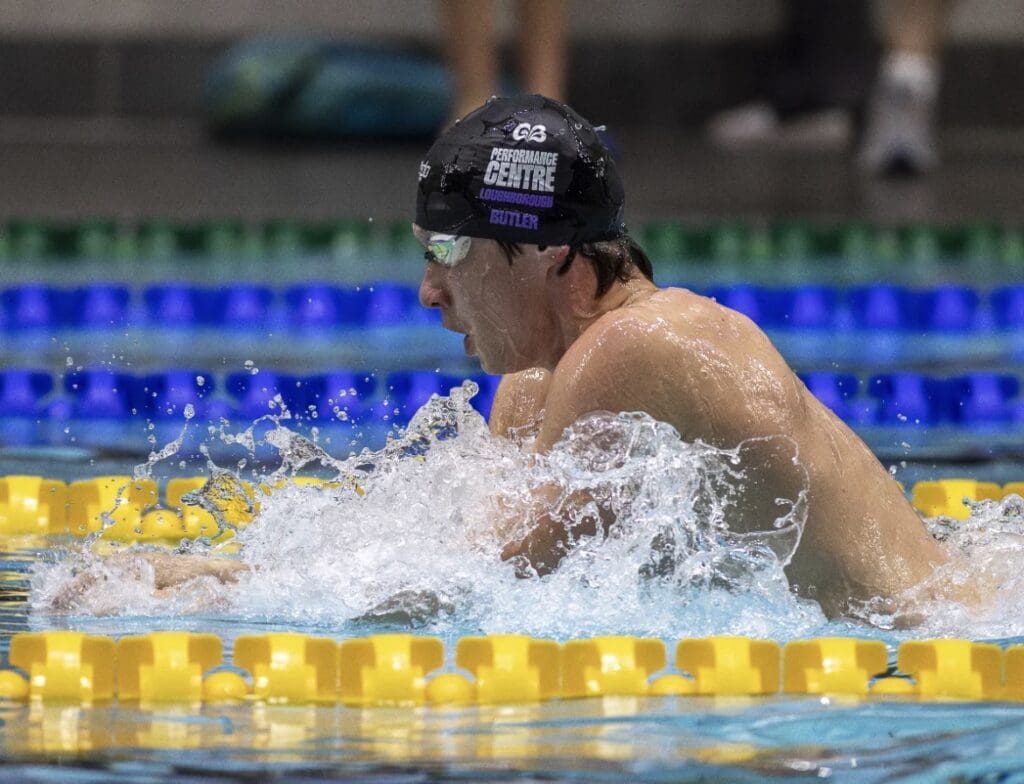
Training under Mel Marshall alongside Adam Peaty, the undisputed king of world breaststroke, provided world-class training, though Butler eventually found growth by stepping out of that familiar environment.
“It was really special. It was just incredible watching Mel and Adam mainly because we saw it from the start of Adam’s career and when he was first breaking world records and winning Olympic gold – it was really special to watch that and then to be a part of it when I was really young,” he says.
“It’s really important you had a lot of trust in what you were doing. Training with the world record holder. You kind of were really just enjoying it and absorbing everything. It was really helpful, obviously you’re learning from the best in the sense of Mel and Adam and it was really inspiring and he was really helpful in so many ways.”
Navigating major international meets brings an entirely different set of pressures. Butler’s early medal breakthrough on the senior stage came with complex emotions, particularly during the 2022 Commonwealth Games and U23 European Championships.
“I think my first medal was the 2022 Commonwealths, but that was part of a relay. I didn’t go into the meet thinking I’d be doing any relays really because you had James Willby and Adam Peaty, but I was chosen for the heats.
“It meant that I came out of that with a gold and a bronze but I had a bit of a weird feeling around it because my splits were really poor. I wasn’t happy with them. So I had these medals but I didn’t really feel like I earned them. I wasn’t really that proud of them.”
The ultimate test of mental endurance came during the Paris Olympic Trials, where the psychological burden of racing against the clock to swim under Team GB’s strict consideration times proved to be an uphill battle.
At the time of racing, Butler’s best time was just over a second away from the consideration time to be taken to the 2024 Paris Olympics.
“You just have to use it to your advantage and feed off it and not let it overwhelm you or get too bogged down with it. It’s a fine balance. It’s something which takes a really long time to get to grips with.”
“I was still quite young going into Olympic trials that year. I wasn’t ancient. I had the belief that things like that, when there’s so much on the line and there’s so much adrenaline, I do think it’s possible to race these crazy swims where you can cut that much off your time. I was confident you know, I had the best training block of my life and you’re going to get so much from that and just manifesting it. “
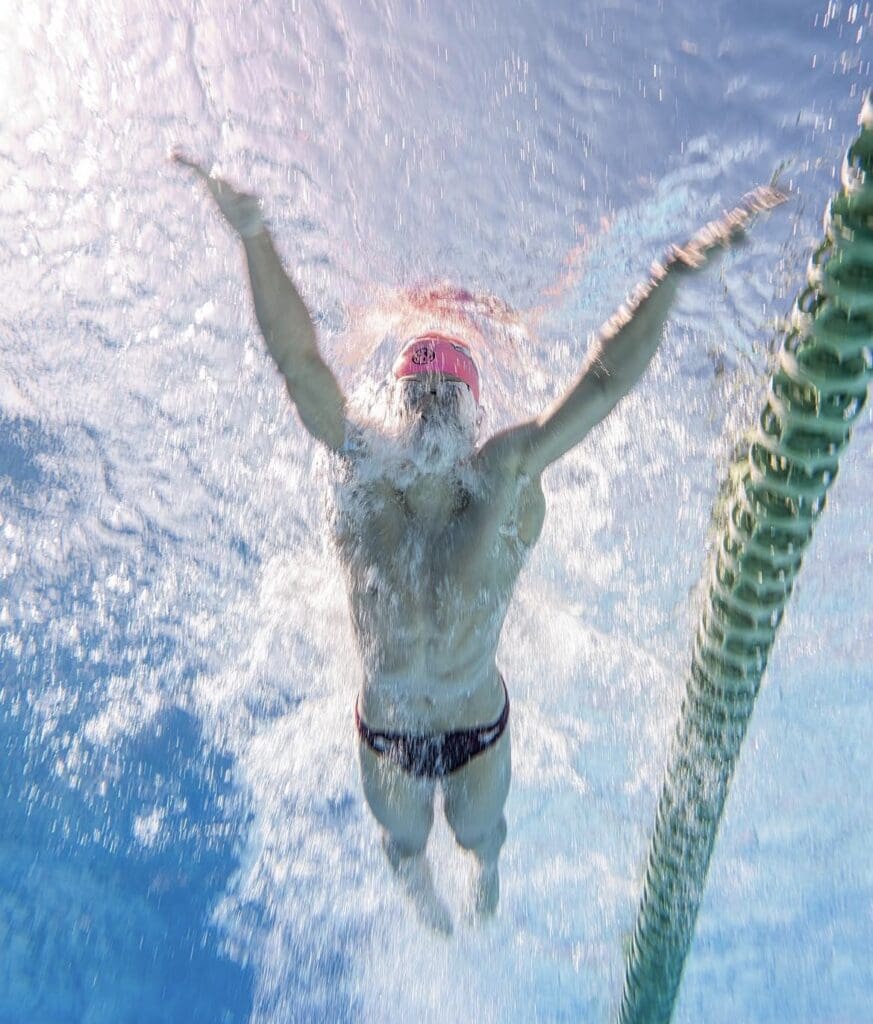
The meet ended in immense disappointment, after Butler failed to meet the consideration times for both the 100m & 200m breaststroke, which sparked a deep period of reflection after missing out on selection and facing financial uncertainty.
However, James Wilby, who did win the title in the 200m, still failed to clock in under the consideration time – which meant he wasn’t picked to swim that event in Paris, despite rightfully earning his place in the 100m. This shows the ruthlessness of the sport and for Butler – he’d reached a crossroads.
“I was gutted. It was a really bad 100m final where the occasion got the better of me and I just dived in and I was just spinning,” he says. “I was just on my arse for the whole second half, I was way off it. That drained me for the next few days so going into the 200 by the end of the week I was emotionally drained.”
“It was a real mental battle because I was dropped from the funding programme before the trials, I was finishing studying, not earning any money – is there any point in keeping trying to do this? I had to really think and weigh it up to see if it was the right move.”
“Mel left after the Olympics, so then it was the new possibility of a new coach and I was curious. I thought I might as well, even if it’s one more year, stick it out and see how it goes.
I felt like I had unfinished business and I was definitely confident that I could go a lot faster still. I ultimately decided to carry on.”
That resilience paid off spectacularly at the 2025 British Championships, where Butler finally shattered the long-standing personal barrier of finishing in under 60 seconds in the 100m. He also claimed the 100m and 200m breaststroke men’s GB titles.
“That was a really long time coming,” Butler smiles.
“I was happy to get those titles in 2025, especially with the history of British breaststroke.”
With the Commonwealth Games and European Championships on the agenda for summer 2026, Butler’s perspective on recovery has evolved into something structured yet fundamentally straightforward.
“I was really happy to make both of them as well because it was tough – you’ve got Adam coming back, absolutely flying, and I am really looking forward to hopefully moving on again in the summer,” he says.
“My main goal is just to PB, but I also really want an individual medal at Commonwealths to push towards Europeans. I’d love to win a medal at Europeans, but I just want a strong performance in the finals.”
Butler notes what recovery techniques make the biggest impact on him.
“I guess the two main things that are pretty simple: good nutrition and good sleep. But, it’s easier to manage these things when you’re in full time training.
“Also, the centre is great – we have access to ice baths, we’ve got our physio work, a nutritionist so all these things make it really easy for us. We have to take advantage of it.
“We are really lucky at Loughborough. We have a power base, we’ve got all these amazing facilities, our fantastic camera system. I’ve never seen one of these camera systems anywhere else really.
“Once or twice a week we check in on our strokes on the cams, but I mainly use it to perfect my starts.”
“I can’t complain,” Butler concludes on his current mental state. “Training is going well, we have one more competition before the major comps this summer.”
Butler’s journey is a striking reminder of what it truly means to recover in elite sport. Physical recuperation requires ice baths, state-of-the-art camera arrays, and world-class nutritionists, but true athletic longevity demands a specific type of mental resilience.
Having faced hardship in his loss of funding and the immense heartbreak of missing out on the Paris 2024 Olympic selection, Butler chose to trust a revamped coaching process and push forward.
As he targets individual podiums on the international stage this summer, his career has shown that the hardest setbacks truly do fuel the most meaningful comebacks.