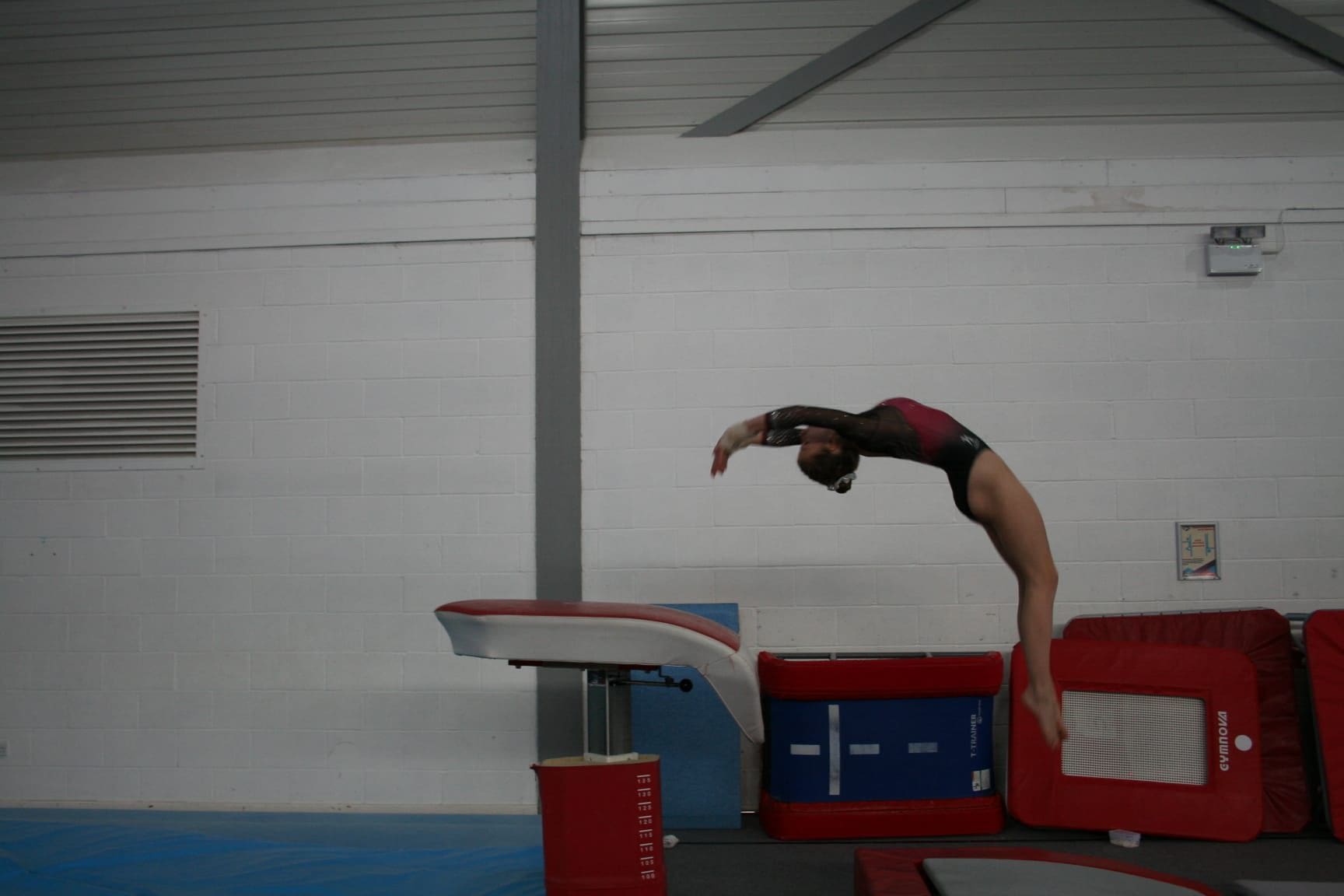
A torn ACL may be seen as the worst moment of an athlete’s career. For one former elite gymnast, it became a way out.
Most athletes remember a torn ACL as the day their world ended. For Lucy Steward, it was the day she was finally allowed to breathe.
“I knew they’d let me go because there was no benefit in keeping me,” she says. “That injury gave me an escape.”
Today, Steward is back on the mats at the University of Bristol, competing in BUCS leagues with a smile that was missing during her decade in the elite development tiers. But the path from a career-ending snap to her current ‘laugh and a giggle’ training sessions was far from straightforward.
Gymnastics looked very different for Lucy Steward in 2019. In the elite development tiers, the sport is rarely just a hobby; it is a structured, intense, and all-consuming lifestyle.
At age 14, she was at the peak of the old national performance pathways. She had just competed at the national finals for Grade 1 – the highest level for her age group. Success in this environment requires a singular focus that often leaves little room for a social life or personal identity outside of the gym.
But just a week after the national finals, the physical demands of the sport caught up with her. During training, while practicing a double-twisting backwards somersault on the floor, her landing went wrong.
“I did my ACL in May 2019,” she says. “Saying it now is kind of crazy because it seems like yesterday, but it was about seven years ago.”
For a young gymnast, the ACL is central to explosive power and stability. It provides the rotational control required for the twists and tumbles that Steward was performing.
A tear is devastating – not just physically, but statistically. Many gymnasts never return to the same level of performance. Knowing this, Steward sought private surgery just over a month after injury, hoping to bypass long waiting lists and bounce back as quickly as possible.
“They didn’t do ACL reconstructions on the NHS for a 14-year-old, so I was really lucky I had that,” she says.
Surgeons initially attempted to repair the existing ligament by tying it back together, but the procedure failed. Steward eventually required a full hamstring graft reconstruction – considered the gold-standard procedure for athletes – followed by a grueling, multi-phase rehabilitation process.
Throughout the early stages of recovery, Steward continued attending training sessions, doing whatever she could despite her injury. But beneath the surface of the ‘determined athlete’ narrative, a different realization was beginning to form.
Six months after surgery, Steward made the decision to quit gymnastics altogether.
While the injury was the physical trigger, the psychological strain of elite training had been eroding for years.
“There was definitely a buildup of reasons for me leaving,” Steward says.
“I’d had issues with coaches not being particularly nice, and then with an injury like mine, which was going to be such a big task to come back from, I was almost allowed to leave.”
In December 2019, after ten years of elite-level training, Steward walked away.
In the world of sports recovery, experts often talk about ‘bridge sports’: activities that maintain an athlete’s physical literacy, while removing the specific pressures of their primary discipline. For Steward, that ‘bridge’ became trampolining.
Around the time she quit gymnastics, she was introduced to Jane Lanaway, a trampolining coach running sessions at her school. Steward initially helped out as a coach before considering a return to training herself.
“I thought I could give it a go,” she says. “It put less pressure on my legs, it seemed safer, and it was similar to gymnastics.”
Trampolining offered a lower-impact environment for her reconstructed knee while allowing her to maintain the spatial awareness vital to a gymnast. She quickly became passionate about the sport.
“I think it was because I was excited to do flips and learn new skills again after nine months,” she says.
“I went into it thinking, ‘I’m not sure I’d want to compete in it,’ but very quickly I was competing and wanting to learn more.”
Her gymnastics background served as a massive advantage. Within two years, she was competing nationally in her age category.
For a time, trampolining filled the void. It offered the thrill of the ‘flip’ without the toxic environment of her previous club. However, as she turned eighteen, the excitement began to fade. The combination of A-levels, work, and coaching made the sport feel repetitive.
“It became more of a stressful thing going on,” she says.
Lingering knee issues forced more time away from the trampoline.
“I just got to the stage where I wasn’t finding it as fun anymore. I loved learning the individual skills, but I hated putting them into a routine and actually competing.”
The high-pressure nature of trampolining routines – where one mistake can end your entire performance – began to mirror the stress of her earlier gymnastics career. By January 2023, she decided to quit trampolining, too.
But the ‘bridge sport’ had served its purpose: it had kept her body moving and her mind engaged with the fun of new skills.
The final stage of Steward’s recovery came at the University of Bristol. After starting university in September 2023, she joined the gymnastics society. Initially, the environment felt dangerously familiar. One of the coaches, Rory Weavers, had an elite pedigree, having coached Olympic gymnast Claudia Fragapane.
“I saw him, realised it was a bit more proper, and was like, ‘this is trauma all over again,’ but he’s lovely once you get to know him,” Steward says..
Once she settled in, Steward discovered the environment was relaxed and, most importantly, self-directed. In January 2024, she began training regularly again. Freed from the pressure of elite coaching, her progression skyrocketed. The skills she learned as a child returned, now paired with the maturity and spatial awareness she had refined during her trampolining years.
“The university group is quite small. It’s a close little family,” she says. “No one takes it too seriously. We all have a laugh and a giggle, and everyone falls all the time.”
Ironically, by removing the fear of failure, success came naturally.
Looking back, Steward credits that period of trampolining as the key to her psychological recovery. Without that detour, the trauma of her elite years would likely have kept her away from the mats forever.
Today, her relationship with the sport is defined by choice rather than pressure. She competes in BUCS leagues and is even considering a return to more serious training for the English Championships after graduation.
“I think that might be a summer thing; give it a go and then try to do the English championships next year, but that’s still a maybe.”
Her family remained a mirror of her journey: her mum was thrilled to see her back in her element, while her dad only saw the risk of reinjury. Her friends have been supportive but cautious, reminding her of the version of herself that elite gymnastics had worn down as a child.
But Steward has completely reinvented her training life.
“I’m not under pressure from anyone,” she says. “A lot of ACL injuries are career-ending. In a way mine was, but I’ve spun it to start a new career. I wouldn’t relate my gymnastics now to my gymnastics then. They’re two separate careers.”
In sports recovery, success is often measured by the speed of returning to the sport safely. But Lucy Steward’s story suggests it should also be measured by the athlete’s happiness.
When asked whether her relationship with gymnastics is healthier now than ever before, her answer is immediate: “100%.”