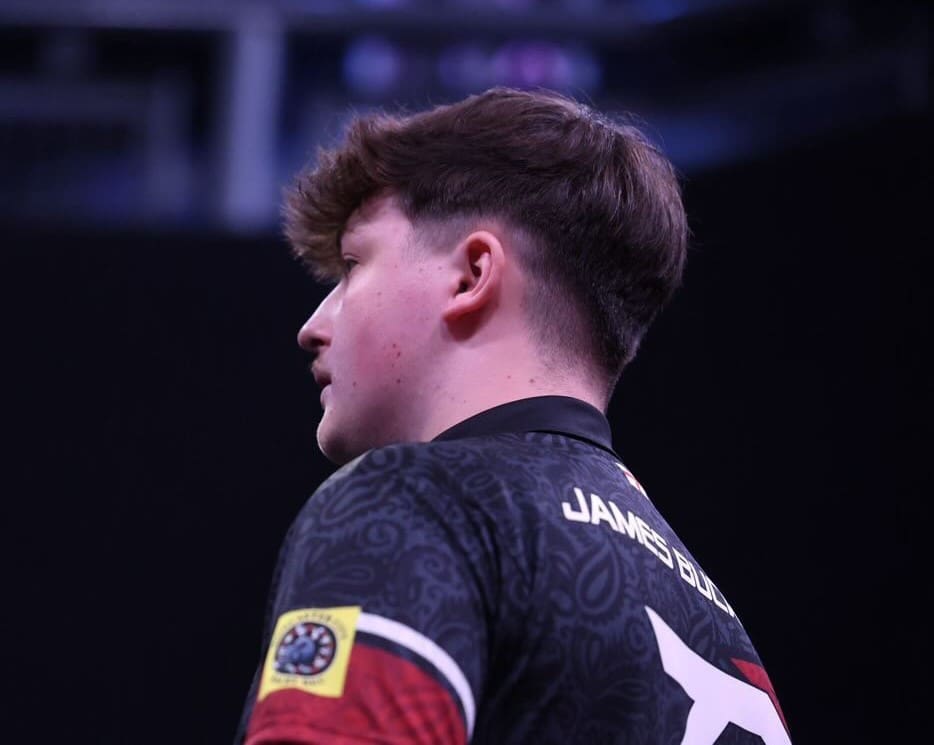
Darts is often described as a game of rhythm and mentality, and few moments showed that more than James Buckby’s widely discussed miscount at the MODUS Super Series. Speaking exclusively to Back in Action, he reflects on handling the pressure of the situation and the reaction online.
For a split second, James Buckby looked completely lost.
119 points remaining for the match, Buckby wired what should have been a routine combination finish. Single 19, treble 20, but instead of leaving double 20, he believed he had left the bullseye. The moment the realisation hit, bemusement flashed across the face of the 22-year-old.
Within minutes, the clip had spread across social media. Comment sections filled with accusations questioning his integrity, and in an era where every dart is dissected online, one honest mistake suddenly became subject to ridicule.
Buckby went on to lose the match in that last-leg decider and for many players, that moment alone could have unraveled an entire week’s work. Instead, he responded by producing some of his best performances on record.
By Saturday night, the same player left stunned on stage days earlier had fought his way to his second consecutive weekly final at the Modus Super Series. Although he fell short once again, the story of his week had already changed and it was no longer about the miscount, but more about the response.
For Buckby, the biggest challenge was not the maths. It was finding a way to reset while the entire darts world watched.
“I looked up and thought…that’s not right”
The immediate aftermath of the mistake was difficult for Buckby to escape. Not only had it cost him an opportunity against 16-year-old Archie Self who was unbeaten at the time, but he still had matches left to play with the moment fresh in his mind.
“I realised I had miscounted when I threw the dart at the bull and the referee kind of hesitated,” Buckby says. “And then looked a bit confused. He said I had scored 104 and I thought ‘well that’s not right’ or something just didn’t feel right. I then looked at the scoreboard and it said I had 15 left, I really quickly did the maths again and that’s when it hit me.”

For a player still early into his senior career, the public nature of the error added another layer to the frustration; MODUS events attract audiences online of seven to eight thousand viewers and the clip quickly became the main talking point of the session. Buckby admitted his first thoughts were centered around the timing of it all.
“First of all, I thought, ‘I look really stupid on the telly in front of probably a few thousand people watching,’” he says. “Second, what a time for it to happen when I was three each against a lad who hadn’t lost a game yet and I realised I’d just thrown a match dart at the wrong target.”
The pressure only intensified when Archie Self failed to close out the match immediately, handing Buckby an unexpected chance to recover. Instead of settling back into the rhythm, the rush to repair the situation caused his focus to unravel further.
“Stuff like that doesn’t normally bother me too much anymore. But that time I just let it completely get to my head,” he admits.
What followed over the next 48 hours would define Buckby’s week far more than the mistake itself.
The noise that followed
Once the session ended, Buckby struggled to switch off from the moment and it replayed in his head for hours, especially given the context surrounding it. Earlier in the day, he had already missed six match darts in another defeat and instead of sitting unbeaten in the group, he suddenly found himself fighting to stay in contention.
“It was about two hours afterwards,” Buckby says. “I had a phone call with my mum and dad and a FaceTime call with my mate. I just couldn’t really stop thinking about it, I was absolutely kicking myself.”
The frustration soon became harder to ignore once clips of the mistake began circulating online. While he understood why the moment attracted eyes, he admitted seeing accusations of match-fixing attached to the clip was difficult to process.
“I was a bit gutted because I really thought in my interviews it was showing how much I appreciated these kinds of opportunities, and just really enjoying being there and giving it my all,” he says. “And to see people accuse me of losing a game on purpose hurts a little bit to be honest.
“I saw the messages, I had three really horrible, explicit ones and I actually found them quite funny… it was a bit of a mind-blowing moment that I was in that position where people say that about me.”
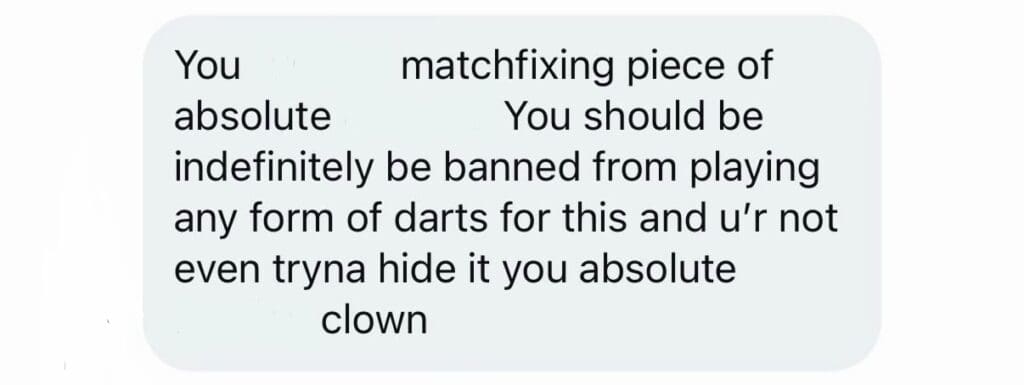
Despite this, Buckby refused to respond publicly. Instead, he used the criticism as motivation heading into the remaining sessions.
“I used it to spur me on and thought I would show them what I’m about to qualify anyway.”
Letting the darts talk
By the time the next session arrived on the Friday, Buckby’s focus had shifted away from the mistake itself and towards keeping his week alive. Perspective slowly returned after conversations with family and close friends, helping him reframe what had been an emotionally draining opening day.
“I just thought to myself, it’s such a tough group, I would’ve taken two wins and two losses before the session started,” he says. “So that boosted me a bit and gave me a pick-me-up for the next session.”
The response on the board was immediate. Buckby finished the second night with his second win against Willie Borland, in which the pair equalled the record for the most 180s in a single MODUS Super Series match. In his first game against Borland, he had recorded a 103 average, his highest over the game format. These performances reignited his confidence at exactly the right moment.
“That was against a darting hero of mine,” Buckby says. “So I had kind of built off the good things in the session.”
As results improved, so did his mindset. Rather than allowing the attention surrounding the viral clip to linger, Buckby became increasingly motivated by the idea of proving he belonged at that level regardless of the noise around him.
“Wouldn’t it be great if I just did really well this weekend after that?” he says.
That mentality carried him all the way to another weekly final by Saturday night, completing a turnaround that few would have expected after the opening day. Although he narrowly missed out on the title, Buckby believes the run remains one of the proudest moments of his career so far.
“Going from that moment on day one to reaching the weekly final, that’s probably the overall achievement that I’m proudest of so far in darts,” he says. “I really thought I’d messed up my chances.”
More than one mistake
For Buckby, the experience highlighted just how mentally demanding darts can be away from the stereotypes often attached to the sport. Unlike physical sports where recovery is usually visible, darts offers little time to process mistakes once a match begins.
“On that stage, you’re on your own,” he says. “If you miss a few darts to win a leg you have to instantly put it behind you because there’s no breaks, you can’t take a five minute breather in between legs and you never know when your next opportunity’s going to come.”
That pressure only intensifies in an era where mistakes are instantly clipped, shared and debated online. Buckby believes the individual nature of darts can make players particularly vulnerable to criticism, especially from people watching from behind a screen.
“People love to talk,” he admits. “Everybody thinks they know best and people will say mean things because they think they can do better and they’ll try to put you down.”
For younger players watching on, Buckby hopes the biggest takeaway is not the mistake itself, but the response that followed it.
“You’re not any worse than you were before that one error,” he says. “Everybody has bad darts no matter the level. You’ve just got to move past it straight away and know it was a blip.”
In a week that began with ridicule and self-doubt, Buckby ultimately proved something far more important than whether he could count under pressure. He proved he could recover when everything around him threatened to spiral the other way.