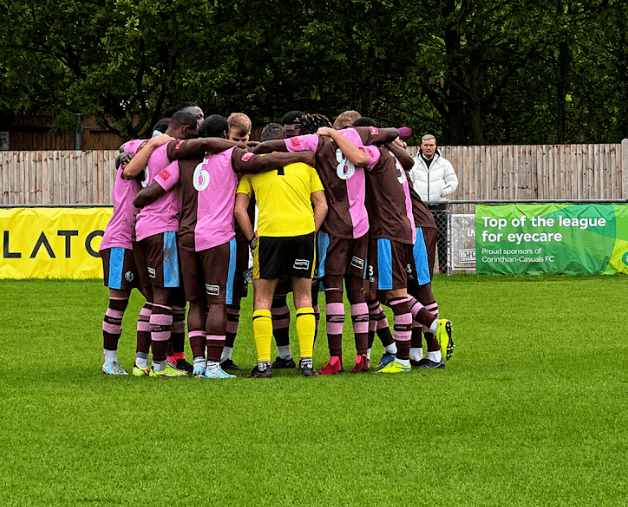
Behind the glamour of the professional game, clubs like Corinthian-Casuals fight simply to keep going. Chairman Brian Adamson explains why resilience has become non-league football’s greatest strength.
For more than a century, Corinthian-Casuals FC has existed as one of English football’s greatest survivors.
Formed through the merger of amateur giants Corinthian FC and Casuals FC in 1939, the club carries a history that stretches deep into the foundations of the modern game. Corinthian sides once helped spread football across the world, inspired the creation of clubs such as Sport Club Corinthians Paulista and built a reputation for playing the game the right way.
Today, Corinthian-Casuals paint a very different picture from the flamboyance of their Brazilian namesakes. Like so many clubs across non-league football, survival has become part of their identity. Every season brings another rebuild. Beneath the glamour of the professional game, clubs like Casuals exist in a constant cycle of recovery.
Chairman Brian Adamson knows that reality better than most.
“Non-League football can feel like starting again every summer,” he says. “But that is also part of the challenge and character of a club like ours.”
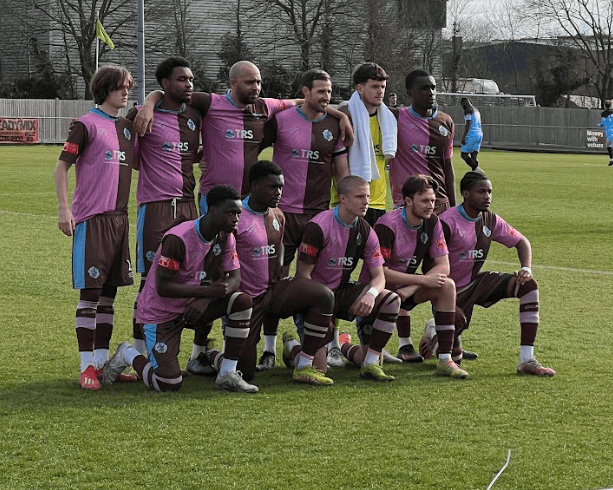
The endless rebuild
For amateur teams at this level of the game, stability is a luxury few can afford.
At clubs like Corinthian-Casuals, rebuilding is not viewed as failure, it is simply part of survival. For a club with roots stretching back to the foundations of modern football, there is little room for sentimentality in the realities of non-league life.
For Adamson, one of the most difficult parts of non-league football is watching progress disappear just as quickly as it arrives.
“You work hard to build relationships and create a team spirit,” he says. “Then, naturally opportunities arise elsewhere for them. We never stand in the way of players progressing, but losing quality and experience regularly does create challenges.”
The impact of this constant turnover stretches far beyond the pitch. At this level, clubs are built on shared sacrifices, and connections form quickly, which makes departures harder to absorb.
“There is definitely an emotional impact because these players become part of the club. Supporters connect with them, management invest time in them and dressing rooms build strong bonds.
“When players leave, particularly after difficult periods where everyone has worked hard together, it can feel like losing part of what you were building.”
For Adamson, the challenge is not simply replacing players, but protecting the identity of the club while everything around it changes.
“Momentum in football often comes from continuity,” he says. “At our level, that can disappear quickly.”
The constant in the chaos
While players and managers may come and go in non-league football, Adamson believes the true identity of Casuals has always come from the people who remain.
“Supporters are vital,” he says. “During difficult periods or rebuilding phases, supporters provide stability and belief. They remain the constant connection between the club’s past, present and future and their loyalty gives everyone at the club motivation to keep pushing forward.”
Behind the scenes, that resilience stretches even further than the terraces. Casuals are one of the few clubs in their division to not provide a salary for their players and staff. The club survives and relies on volunteers and community support to give support to keep the club alive week after week.
“People often only see what happens on a Saturday afternoon,” Adamson says. “But they don’t always see the work behind the scenes. We rely on people giving enormous amounts of time and energy simply to keep us operating.”
At Casuals survival is not built around any one element or individual. It is built around people repeatedly refusing to let the club disappear.
What resilience really looks like
For Adamson, resilience at Corinthian-Casuals is not measured through league positions or dramatic comeback stories. It is measured through the club’s ability to keep moving forward when circumstances try to pull it backwards.
“It has taught me resilience is not about avoiding setbacks, it’s about responding to them,” he says. “Football constantly gives you challenges and uncertainty but this club has always found a way to keep moving forward.”
In many ways, that mentality reflects the wider reality of football at this level itself. Survival depends less on perfection and more on persistence and clubs are often forced to think differently.
Protecting the club’s identity through these difficult transition periods carries enormous responsibility and for Adamson, he feels this pressure immensely.
“Corinthian-Casuals is bigger than any individual. My role is to help protect the values of the football club while making sure it continues to move forward.”
This responsibility becomes harder when uncertainty never fully disappears. Yet Adamson believes the character of the club has been shaped by learning how to respond when things become difficult.
“The clubs that survive are the ones that refuse to give up,” he says.
In this sense, Adamson believes the phrase ‘Back in Action’ resonates with the club perfectly.
“No matter what challenges the club faces, whether on or off the pitch we always respond to come back fighting.”