
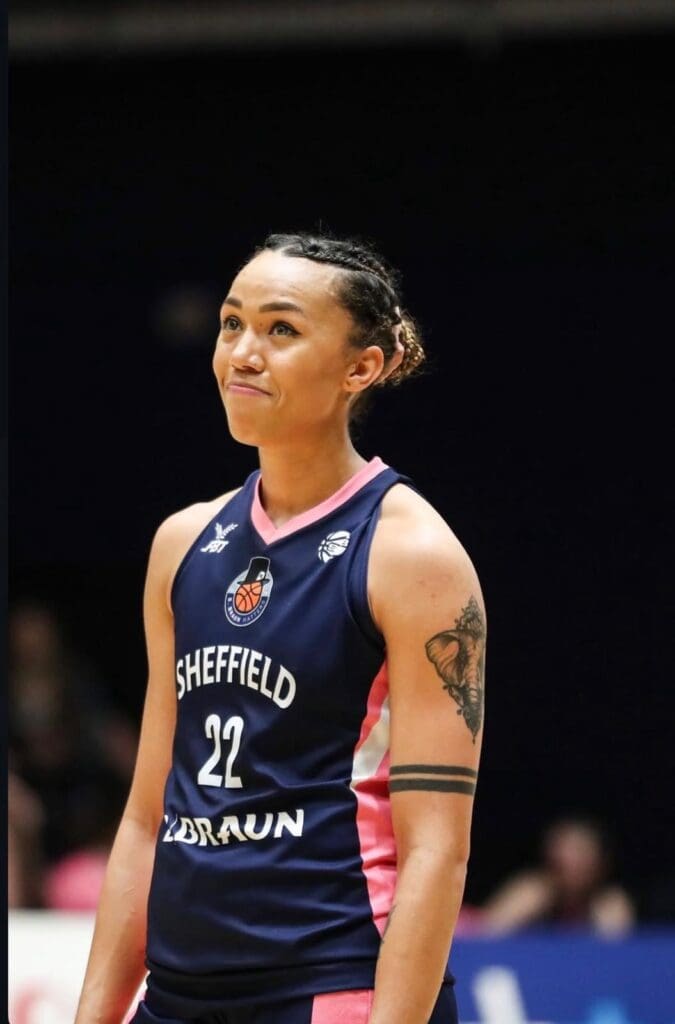
The Sheffield Hatters star reveals how recovery, yoga and learning to listen to her body helped power the most successful season of her career.
Four trophies. MVP. Defensive Player of the Year. An unbeaten home record. For most players, that would earn a summer off. But, for Megan Mullings, it meant landing back in Australia on a Thursday evening and preparing to play again almost immediately.
“I got in on Thursday evening. One of my friends picked me up from the airport and asked if I wanted to stop by practice,” she says.
That mentality explains a lot about Mullings’ debut season with the Sheffield Hatters. The standards never dropped. The intensity never softened. Even after winning everything there was to win, Mullings speaks like someone that’s still trying to prove something.
At 33, Mullings says she can still physically do everything she could when she was younger.
The difference is what it costs afterwards.
“I’m one of the oldest players now in most leagues that I play. The biggest difference is not what you see on the court,” Mullings says. “I can still run as fast. I can still jump as high. I’m getting smarter as I get older. But it takes me twice as much to recover now. Every single week I was seeing somebody, at least two to three times a week, for something.”
Hatters provide their players with an abundance of recovery treatments; from massages on Thursdays, to physio appointments on Mondays and Wednesdays, they are able to access expert advice around the clock.
However, there still comes the extra work.
“We also sought out going to Rise and doing ice and hot therapy,” she says. “We did saunas which then led to a lot of yoga, and all of that helped – especially with my fascia.”
Mullings speaks about recovery with the precision of somebody who has learned the hard way.
“So many of our injuries as basketball players are due to getting hit or inflammation. If you can reduce that inflammation through compression boots, through ice and heat, it makes such a difference.
“I used the compression boots before the finals because my calves were so tight from all the running and stress I was putting on them. For the next two days, I didn’t have any pain in my legs.”
But what stands out most is how seriously she takes the warning signs athletes are often taught to ignore.
“My biggest advice would be: be dramatic about it. As athletes, we’re taught, ‘No, it’s okay. I can struggle through it. I can still play.’ But it’s not normal to be in pain every single day,” she says.
“If your calves feel sore, don’t just throw the ‘it’s okay’ at it. Now you’re carrying something that might impact the rest of your season or the rest of your career. Maybe it’s nothing. But maybe it’s something that just needs treatment.”
For Mullings, that mindset has extended her career.
“If I don’t take my recovery as seriously as I do, I would probably have stopped playing when I was 30 and had my first surgery. But luckily, I took it seriously. At 33, I got MVP after having two surgeries, two and three years prior.”
There is another side to recovery for Mullings though – the side people do not see when the arena empties.
“I have a lot of diagnosed anxiety. I also have panic disorder, and I’ve had that since coming out of high school,” she says.
Basketball is constant noise. Constant pressure. Constant movement. For Mullings, yoga and meditation became survival tools as much as recovery methods.
“There’s not much that I found that helps me stay present in my body, stay in control, even just allow myself to feel whatever it is that I’m feeling, like meditation and yoga does.”
She found a home at Hot Pod Yoga in Sheffield during the season.
“That community is astounding. As athletes, especially as women, there’s very few times in a day where you don’t feel like you have to carry the weight of the world. To have an hour where you don’t have to worry about anything outside of the pod…you can let all that stress go.”
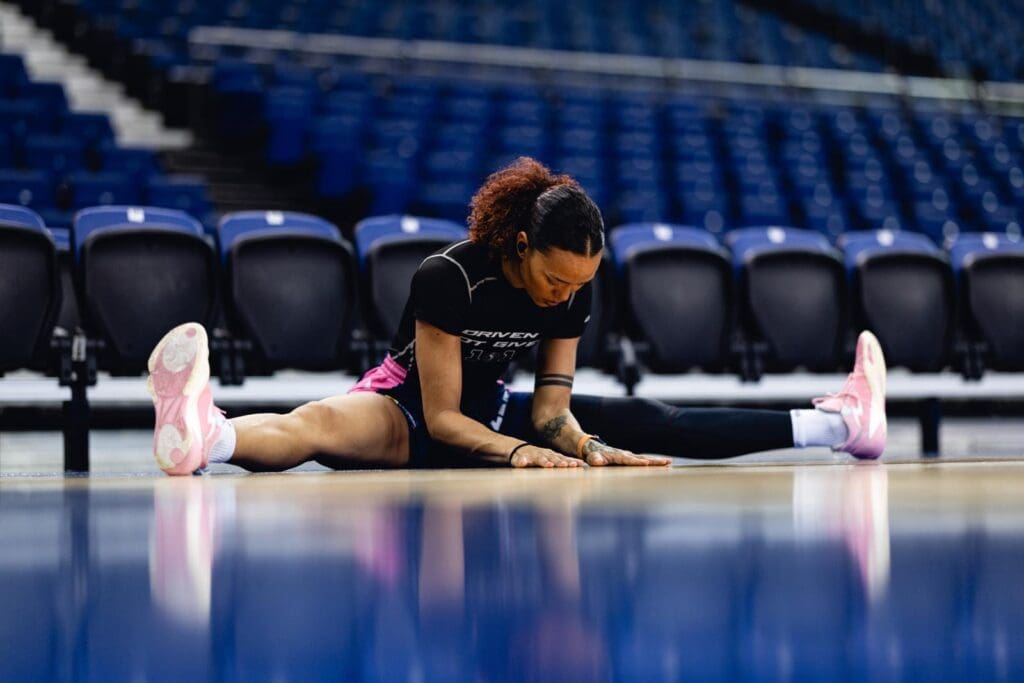
For someone with anxiety, the physical focus matters.
“I don’t do well just sitting and doing nothing because I’m constantly like, ‘There’s something I need to be doing right now.’ But if my body is moving and I’m twisting myself and working on balance, it means all that other noise can’t really exist at the same time,” Mullings says.
Then comes the silence afterwards.
“You lay there and it’s just someone telling you: you are more than enough. Show gratitude to your body. Let go of anything that’s not serving you. That ability to self-soothe and self-regulate… it transfers directly into basketball.
“There was one point in the final where I was grossly sick. Nessa [Head Coach] was talking to us during a timeout and I couldn’t hear her. I could feel my brain starting to go. And I was like, ‘Okay, let’s just focus on breathing.’
“I came out of it and looked at my teammate and said, ‘What are we running?’ Because I genuinely couldn’t hear anything she’d said.
“I was just trying to make sure I had enough oxygen to play.”
That ability to slow everything down in chaos is now something Mullings wants to teach others.
“What I want to do with my life is become a yoga instructor that can help elite athletes find calm in the middle of the storm,” she says.
Even after winning four trophies, Mullings believes the work only gets harder from here.
“Everybody else is going to have to change because they have to get to the standard we’ve now set.”
And maybe that is the clearest insight into why she remains at the top level.
The trophies and personal achievements matter, of course. But yesterday disappeared quickly. It’s on to tomorrow.
However, the whereabouts of Mullings’ future on the court remains uncertain.
Mullings admits she still does not know where she will be playing next season, but also confirmed that discussions are underway between Mullings’ agent and Sheffield Hatters, but nothing has been finalised.
What is certain is that nothing changes in the way she prepares. There is no easing off after the best season of her career. No reward for taking things easy.
Instead, there is another season already underway in Australia.
More work. More recovery.
For an athlete who has built her career on discipline and longevity, that consistency matters.
At 33, Mullings understands that staying at the top is not about one good season. It is about what you do after it. The recovery work continues because it has to. Yoga is a passion that helps quiet the noise.
The standards remain the same because they always have.
And wherever she ends up next season – Sheffield or elsewhere – she will arrive prepared, the same way she always does.