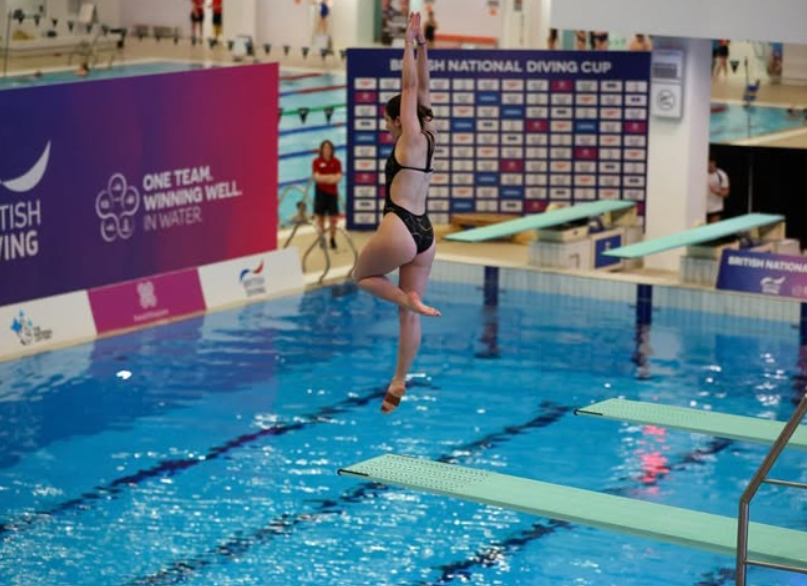
Brooke Ryan was on the verge of beginning her collegiate diving career in the United States when a routine warm-up ended in a devastating injury. She tells Katie Howard about the surgeries, setbacks and emotional toll of spending three years chasing a return to the board.
Athletes typically face retirement with warning signs. Performance drops, motivation fades and the body can’t keep up with the demands of elite sport.
For Brooke Ryan, 20, it came from a single slip.
In March 2023, the diver was preparing for what should have been a routine Saturday morning training session.
After years of progression through the British diving pathway and with a scholarship to study at The University of Arkon, Ohio,and compete in the United States already secured, Ryan was approaching one of the most exciting chapters of her career.
Then in a split second, everything changed.
“I was just jumping on the diving board to warm up,” she says. “My right foot slipped off the board, but my left foot stayed on and rolled. I smashed seven bones in my foot.”
What followed would ultimately bring an end to a sport that had shaped almost half of her life.
“Every diver has slipped off the side of the board at some point,” she says. “People normally sprain their ankle and are out for a couple of weeks. I still don’t understand how I damaged my foot so badly.”
At first, Ryan thought the injury was manageable.
“I saw that it was indented, but everyone around me was just like ‘put an ice pack on it, it will be fine.’”
Although her foot was visibly damaged, Ryan assumed she had suffered a bad sprain and even at the hospital the extent of the trauma seemed difficult to comprehend.
“The person who X-rayed my foot asked if it had been run over by a car,” she says.
“Apparently that type of injury is usually caused by a car running over your foot or a horse treading on it.”
“It was a bit more complicated than just a broken foot. They said I might need surgery, or, could go without,” she says. “They said it was my decision because I was young and healthy, and the foot should heal properly without having surgery.
“I thought I would rather try without surgery first. I had a cast fitted and then went on to walking in a boot, but then they re-X-rayed it and saw it hadn’t healed properly, so I had to go in for surgery.”
At the time, Ryan’s biggest concern wasn’t retirement, it was America.
“Everything was already signed,” she says. “Once I had my first surgery, I thought I’d be fine by August.”
Ryan found herself sitting A-level exams while preparing for surgery.
“I literally went straight from my biology A-level to a pre-op appointment,” she says. “Then the next day I had surgery.”
Even then, she never considered giving up the opportunity she’d worked years to earn.
“I did think, should I take a year out and maybe go the following year, but I just wanted to go.”
Instead, she arrived in America still battling the effects of the injury and facing an uncertain future.
The diagnosis marked the beginning of a rehabilitation process that would stretch across three years, three surgeries and countless setbacks.
But when she eventually moved to America, another emotion emerged.
Guilt.
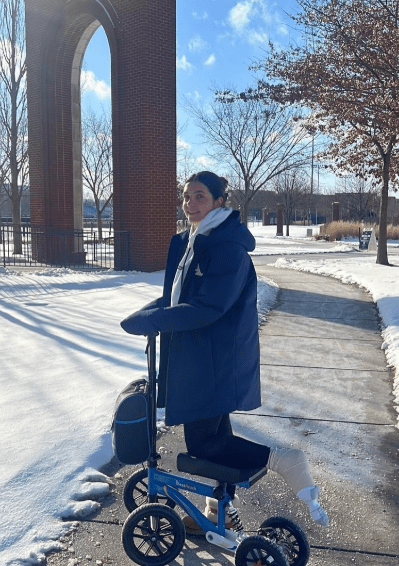
“I felt guilty because they’d given me a scholarship and I hadn’t done anything,” she says. “The coaches kept saying, ‘No, it’s fine’, but I still felt like that.”
“I was just sitting there, not in the pool, just watching.”
“At home, people knew how much I loved diving and how hard I’d worked. But when I got there, they didn’t really know me.”
“I wasn’t diving through any of this. I had tried some one-legged diving just to get me back in the water, but that was it.”
Physically, the injury was relentless. Mentally, the challenge became even harder.
“It was just the same story three times,” she says. “I would get a bit better, try to come back, and then it still wasn’t right.”
“People would say, ‘I wish I didn’t have to do this warm-up’ and I’d think, ‘I kind of wish I was doing it’.”
By the time surgeons had inserted a plate and seven screws into her foot, diving itself had become a distant memory.
“It was more just being really upset that I was missing diving so much. I’ve had injuries before, like stress fractures, but it wasn’t anything as traumatic as that.
“I was just jumping, and then I was in a cast, it was just crazy.”
“If I wasn’t diving, I probably would’ve just stayed in the UK and done a degree here,” she says. “I moved all the way from the UK to America because I wanted to continue diving.”
While teammates travelled to competitions across the country, Ryan often remained behind.
“The first year we’re in the dorms and if you don’t compete, you don’t travel,” she says. “My friends would be away and I’d just be sitting in the dorm by myself.”
As the months became years, retirement slowly shifted from being unthinkable to unavoidable.
“I just wanted to get back but I think people thought about retirement way before I did.”
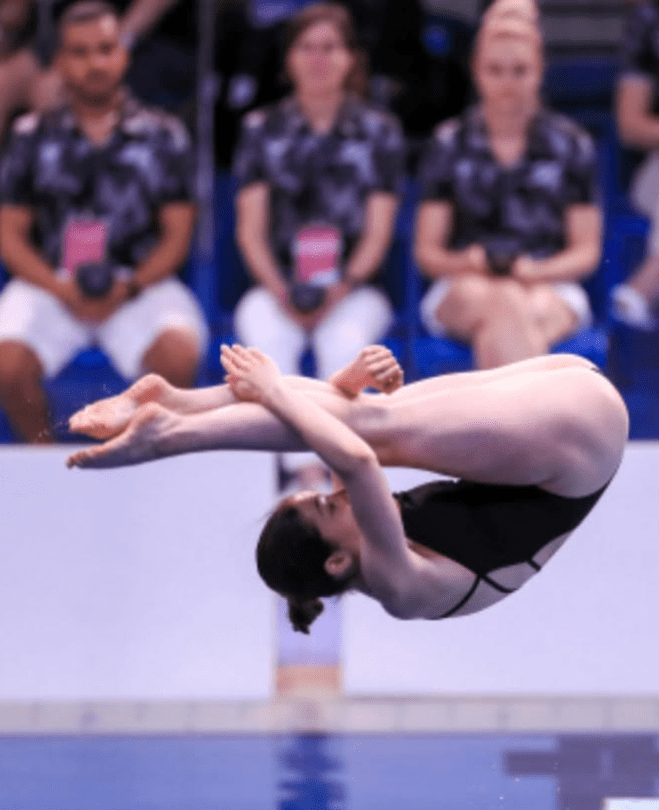
Instead, she continued chasing the possibility that the next surgery or rehabilitation programme would finally provide the breakthrough she needed.
“I wanted to compete in America. I think that’s what kept me going for so long. I just wanted to experience it properly.”
“I had three surgeries in 2 years and it still wasn’t good,” she says. “There wasn’t really anything left to do.
“I had to have realistic conversations with my surgeon, physio’s and my coaches.
“Mentally, I was like, I can’t. It’s been three years now of trying to come back, I just need to move on.”
“If I can’t walk for 20 minutes, I don’t think I can jump on a diving board.”
Retiring in October 2025 brought a mixture of emotions. There was grief for the career she had lost, but also some relief.
“For so long it was trying to get back, trying to get back,” she says. “Now there’s no pressure for diving.”
“When I first retired it was hard because I was thinking, ‘What do I do now?’”
“It’s hard watching the teammates I was supposed to be diving with,” she says. “When I’m actually in that environment, that’s probably when it’s the hardest.”
“The injury has definitely given me some good things. It’s taught me how to persevere. It’s taught me how to let go of something and navigate a different path.
“It has given me more time to focus on my studies, which in the long run is probably more important.”
Ryan now works with athletic trainers through an internship and hopes to pursue a career in physiotherapy.
The athlete who spent years in treatment rooms now wants to help others navigate their own recoveries, a path she never planned to take, but one she is finally beginning to embrace.