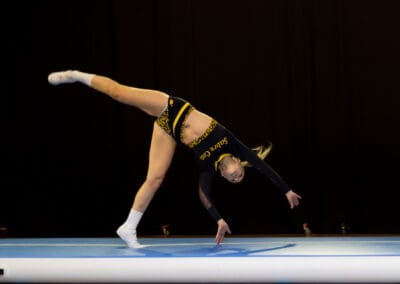
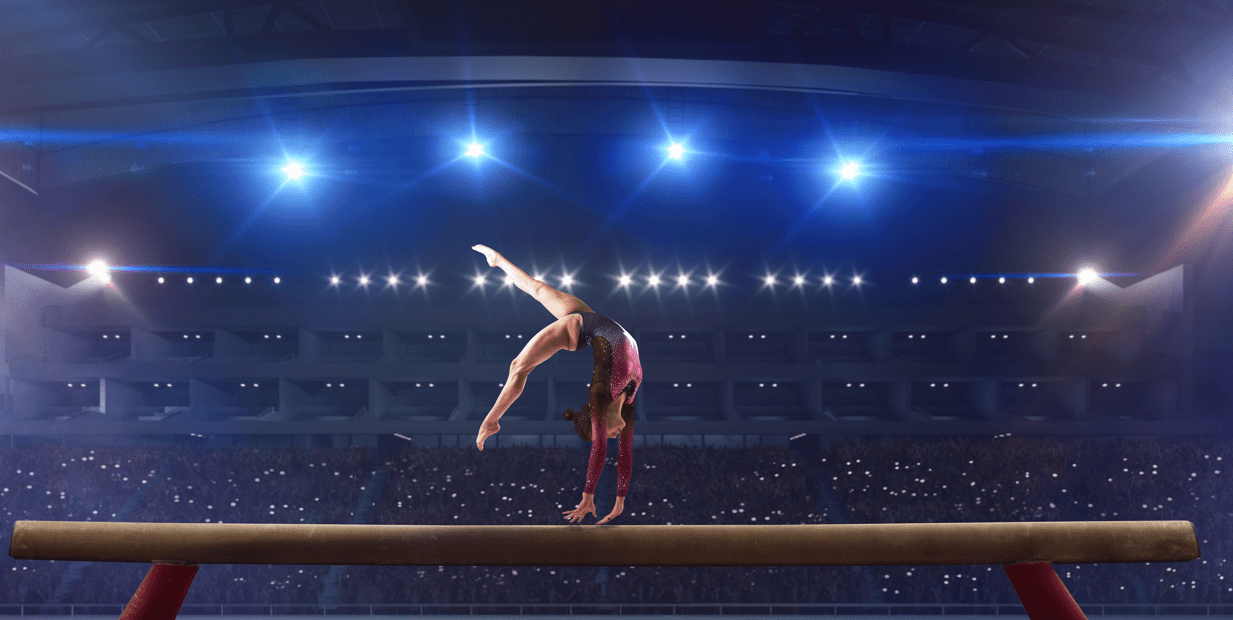
It looks like confidence. It feels like a catastrophe. The twisties expose the fragile line between trust in your body and fear of it – where elite gymnasts lose their sense of self in the air.
Every elite gymnast knows how to twist; it’s as second nature as walking is to people.
What happens when your body disconnects with your mind? When the skill that is as easy as walking feels like a constant state of fight or flight?
That’s what the twisties feel like to a gymnast. Losing your mind mid-air, while doing a trick that, if done wrong, can lead to death.
Dr Rebecca Smith, Director of Complete Performance Coaching, describes it as a sensation of catastrophe.
“When you go to twist, you have this sensation of, you don’t know if you’re going to twist or not,” she says.
“You are flying up and backwards, and feeling completely out of control. It’s as if there’s this blank spot in your mind where the skill used to be.”
Dr Smith was a gymnast until she was 14, when she suffered a mental block. Back then, the solution was to quit – you couldn’t do the skill, then you couldn’t do the sport. Some people still have this mentality today.
As a coach who specialises in mental blocks, she is working to challenge this mindset and educate people as to how the mental block feels from a gymnast’s mind.
“It’s disorienting. Your entire body floods, a pit of doom in your stomach, and the negative thinking comes in, because your brain is doing what it’s supposed to do to keep you out of danger, which is to tell you all the things that could go wrong,” she says.
Mental blocks go beyond fear, says Nicole Smith, a sport and exercise psychologist and Founder of Locked In Sport.
“It’s not, I’m scared to do this, so I can’t do it. It’s an, I am trying to do this, but either my brain’s going blank, or my body’s physically not moving. I feel stuck. I feel frozen,” she says.
The twisties don’t come from a singular cause. They come as a result of various pressures in life, all reaching a boiling point. They are individual to each gymnast. This is why the causes can range – from social issues like anxiety and injuries, to loss of identity.
Neurologically, the explanation leads to what experts call ‘task specific dystonia’ – a movement disorder that affects a highly practiced skill, found in a broad set of expert movements, such as twisting for a gymnast.
However, the root cause still lies in psychology, even if there is a physical aspect to it.
HCPC-registered Sport and Exercise Psychologist, David Charlton agrees with Shapiro’s explanation. He explains it as an accumulation of ‘mini traumas’. The feelings from ‘mini traumas’ you experience get stored in the body until the body pushes back to protect itself.
These ‘mini traumas’ can be sports related, like seeing a friend get injured, or life events, like a bullying incident. If not dealt with this can lead to an accumulation of pressure.
“It’s the brain trying to protect the athlete, it’s a safety mechanism,” Charlton says.
Between the loss of identity that athletes can face before and during the twisties and the stigma that still surrounds the twisties recovery is hard but not impossible.
Simone Biles’ impact, after withdrawing from the 2020 Olympics due to the twisties, has helped gymnasts face the fact that this is a real injury no matter its invisibility. However, there still seems to be misconceptions. People still think that mental blocks are a weakness.
Dr Smith created an online training program called ‘Perform Happy’ which helps athletes, specifically gymnasts with this process.
“True mental block recovery has no quick fix, because you have to literally rewire the brain slowly, with little wins. So you need to find those little wins, and be an excellent communicator through the process.”
Charlton agrees: “It’s two steps forward, then a step back, two steps forward, another step back, and it really challenges.”
Now the question is once you have that psychological safety in your environment, how do you rewire your brain? How do you stop your brain from thinking that you’re in danger every time you try a twist that makes you panic?
There’s various methods that therapists and coaches can use. Every expert recommends the two golden rules. First, don’t push athletes if they aren’t ready, let them decide the pace. Second, remember, an athlete is a human first.
A method that helps gymnasts reach the core issue is visualisation.
“You get them to think about these emotions,” Charlton says. “Understand them a bit more, have a conversation with them. And then you get them to journal. It can be quite a difficult thing to go through – lots of tears. But often it can help them get through the other side of it all.”
The main focus is for a gymnast to rebuild trust in themselves. As Nicole Smith says, “Mental blocks aren’t random, they’re meaningful.”