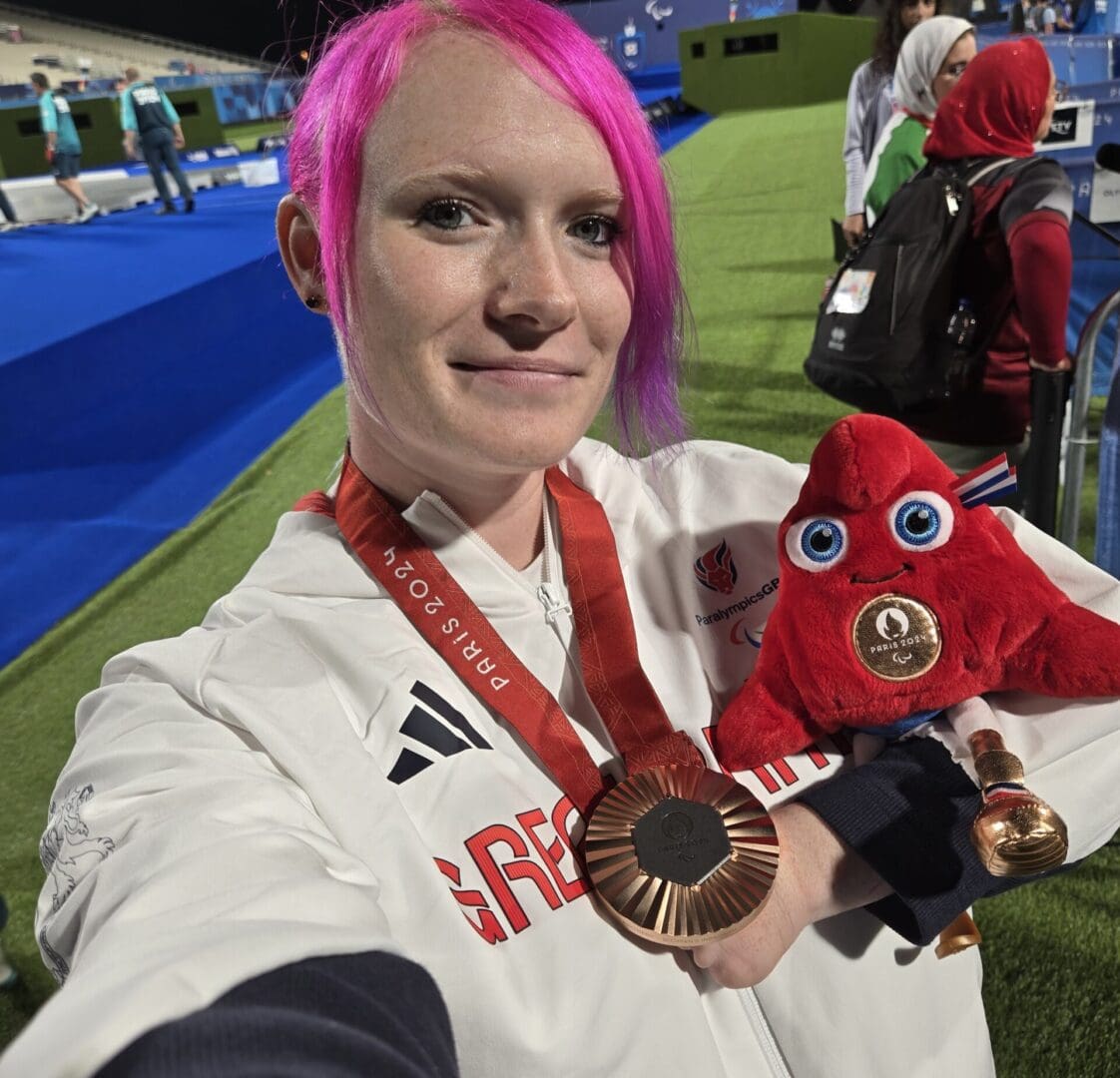
Paralympic archer Jodie Grinham has built a career defined by medals, adaptation, and resilience – but her journey has also been one of coming to terms with her disability.
“Just to do things on a daily basis, I have to dislocate my shoulder to move it. But I was born with my disability, so I know no different.”
This is the reality for Jodie Grinham, who lives with Brachysyndactyly. Her left thumb is partially developed, she has no fingers on her left hand, and a weakened left shoulder.
“I have tried to get on with life,” she says. “But there are things like not being able to do up my bra normally that I struggle with.”
Despite the challenges, Grinham has always carried an ‘I can do anything’ spirit.
Dr Christopher Brown, senior lecturer in sports development the University of Hertfordshire, whose research focuses on disability sport, says this mindset is important in elite sport:
“Disabled athletes should not set a pre-determined limit on what is possible because of their disability and its challenges.”
Growing up independent
Grinham’s first real awareness of her disability came at a specialist school, where staff recognised she was “too strong willed to stay and did not want any help”.
This want of independence proved a stumbling block on Grinham’s journey – particularly when moving into mainstream education.
“I did not accept my disability during my childhood,” she says “Especially as I was bullied and called a freak.”
“I hid my hand by wearing long-sleeved tops, but I also wanted independence and didn’t want people to help me.”
It may sound like she was stepping backwards rather than forwards in her journey, but Grinham was adapting in her own way.
“I was determined to do anything and everything,” she says. “My dad adapted my bike and he taught me how to do my shoelaces.”
“I did energetic sports. I played football and did kickboxing, and once we used nunchucks, but I knew I would never be able to use them.”
“However, my coach made a routine that meant I could be involved without using them and I was amazed that someone made an adaption for me – that gave me hope in humanity.”
Accepting disability sport
Archery entered her life almost by chance. Her dad took part in the sport and she would watch.
“One day, someone came up to me and said I should have a go. Then they looked at my hand and said I couldn’t do it and put a blanket over the sport by saying it was not for me,” she says.
“As soon as they said that, I thought: I’m going to show you and prove you wrong.”
Grinham insisted she would be part of Sussex’s mainstream archery set-up rather than in a disability environment when she first got involved. But then a coach mentioned the Great Britain para-archery team had a talent identification (ID) day coming up.
“I was really against going initially as I did not want to be associated with disability sport,” Grinham says.
Dr Brown says attitudes have shifted significantly over time.
“There has been a change over time in how mainstream and disabled people perceive disabled sports and that is positive.” But a young Grinham was still at the infancy of accepting her disability.
“My dad tricked me to go to the ID day and I was fuming when I found out what I was doing,” she says. “During that day, I was classified to see if my disability meant I could compete at the Paralympics, and when they told me I was disabled enough, I burst into tears.”
“That was a real turning point as I had to start accepting that I was disabled. It took a whack on my self-confidence to say ‘I am disabled.’”
On reflection, Grinham credits the sport in allowing her to take major steps in her recovery. “Although it has taken years to even get close to accepting my disability, the one thing that has helped massively is getting involved in archery as it was the only thing that made me understand my disability,” she says.
The moment everything changed
Charlotte Burgess, Grinham’s coach, remembers their first meeting.
“I was covering a talent day,” Burgess says. “Jodie had issues with her equipment and was bashing her bow with an Allen key like a hammer. I asked if she needed any help and she said no.”
“I went back and offered to help again, and she snapped back ‘no’. I saw her independent side, which is funny because when she has problems now and I offer to help, she says yes.”
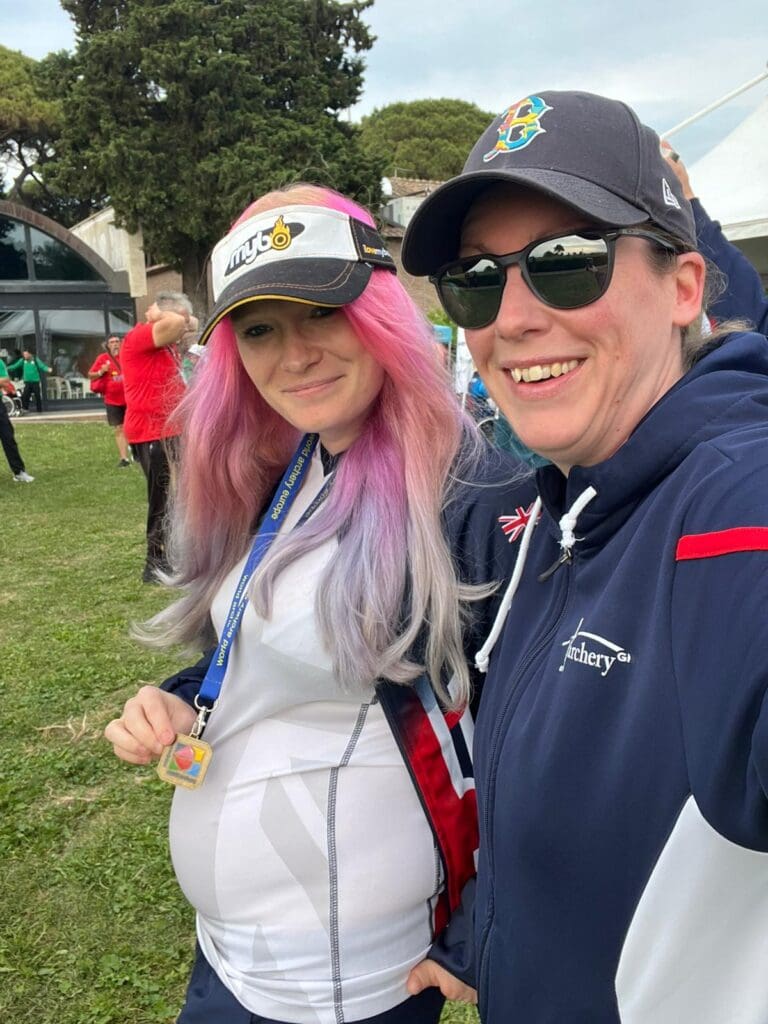
Whilst the ID day was a success, Grinham was not selected for the GB team that competed at the London 2012 Paralympics. “I hadn’t made a proper decision about committing to archery,” she says. “But when I watched the London Paralympics, I thought it looked incredible.”
This inspiration fuelled hours of training over the next four years, leading Grinham to be picked for her first Paralympic Games in Rio in 2016.
Finding belonging in Rio
“As I walked into the athlete’s village, I was met by thousands of athletes with different disabilities. They all related to each other because of their disabilities, and that’s when I realised para sport is for me,” she says.
“Disability is not, and should not, be a word that defines people.”
“I was bullied and people said I couldn’t do this, and I was too weak to do that, but in that village it proved to me disabled people are funny, strong, and can do anything,” Grinham says.
This meant another step forward was taken on her recovery journey, alongside a huge career step as she won a silver medal with John Stubbs in the mixed team event.
Adapting to every challenge
Holding a bow has not always been straight forward for Grinham. She has tried to adapt; from setting playdough around her hand, to having specialist grips made – but not all the adaptations have worked.
“My grip was on my bow, I was due to shoot soon, but because it was so hot at the Rio Paralympics, my grip had melted off. We duct taped and superglued it back on just before I went out,so it showed the challenges I face because of my disability. It was crazy.”
“Before I went to Rio I thought that the Paralympics would be my last, but after those games, I felt it was not my time to step away,” she says.
After recovering from the challenges Grinham’s disability threw at her during the Rio Paralympics, all eyes were on the delayed Tokyo Paralympics in 2021.
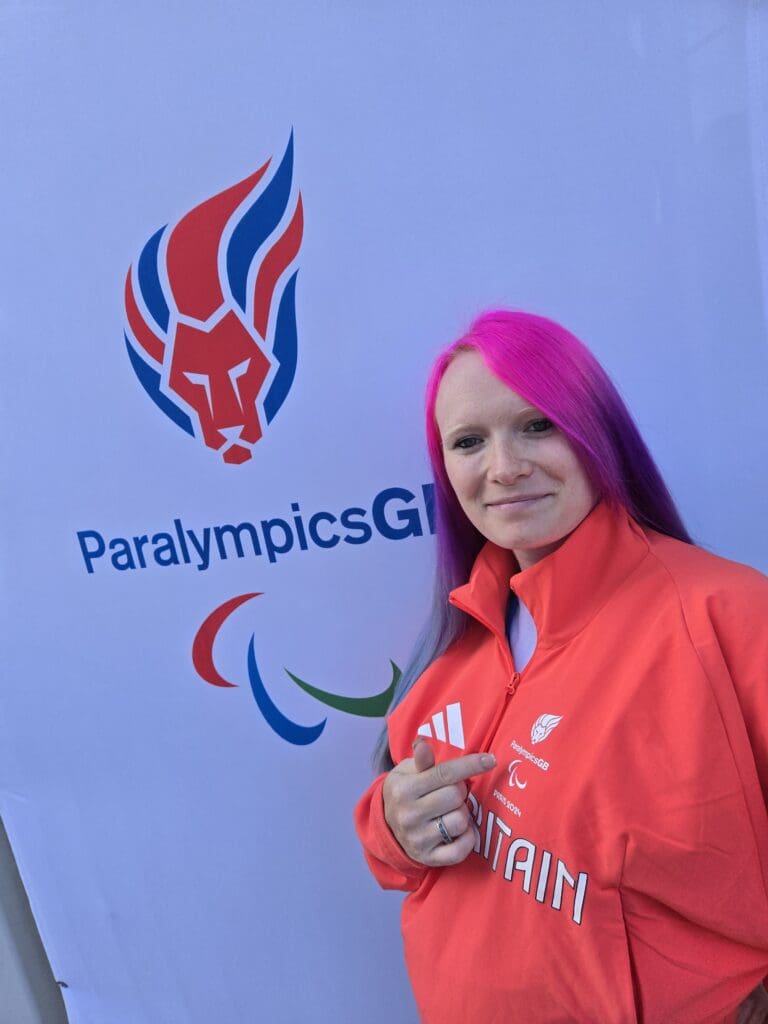
“I had a fall before Tokyo. Whilst I was falling, I was going to land on my left side which meant I would have been injured for longer, so I flipped myself onto my right,” Grinham says.
“But in doing so, I broke my right wrist, ankle, and knee which meant I lost all my independence. I relied on my dad to help me wash and eat, and I felt embarrassed and degraded, but it showed how much I struggle and I need to accept help, but also that I should stop caring about what people think about me.”
This was perhaps the lowest point in Grinham’s career, yet the highest in her recovery; having the realisation of caring less about what people think and accepting help – her supporters were with her every step of the way.
The setback before Tokyo
“We’ve had lots of sessions filled with tears and tantrums, but Jodie can always ring me and I will be there for her as an athlete and a person. That comes from the intimate moments we have shared,” Burgess says.
As part of her return from injury for the Paris 2024 Paralympics, Burgess says that Grinham wanted to be ‘comfortable with being uncomfortable’. Grinham shot with recordings of babies crying in the background to build confidence.
Being uncomfortable is something Grinham has had to experience on her recovery journey. “People said I couldn’t pass my driving test in a manual car, but I did it even though it hurt to drive as my arms are different lengths.”
“I pushed through the pain even though I should not have had to prove I could do it,” she says.
“Jodie never lets anything define her,” Burgess says. “Her disability does not define her. Other people do not define her, and that is why she has been successful.”
Being uncomfortable paid off, with Grinham winning an individual bronze and mixed team gold medal in Paris.
Although Grinham admits she is not at the end of her recovery journey, she recognises there is hope for how herself and others perceive her disability in the future.
“My son is noticing that mummy’s hand is different. We were chatting about it and he said ‘I will put some magic cream on it, there you go mummy, all better now’, and I welled up because it was so wholesome that he tried to make it better. He didn’t think of me any differently because of my hand, I am just his mummy.”
“It really showed that the mentality people have about disability is taught. My son doesn’t treat me differently. It highlights how we can change the way people think as no one should be treated differently.”
“Jodie’s disability is her disability and the way she copes with it is just awesome,” Burgess says. “She owns it.”