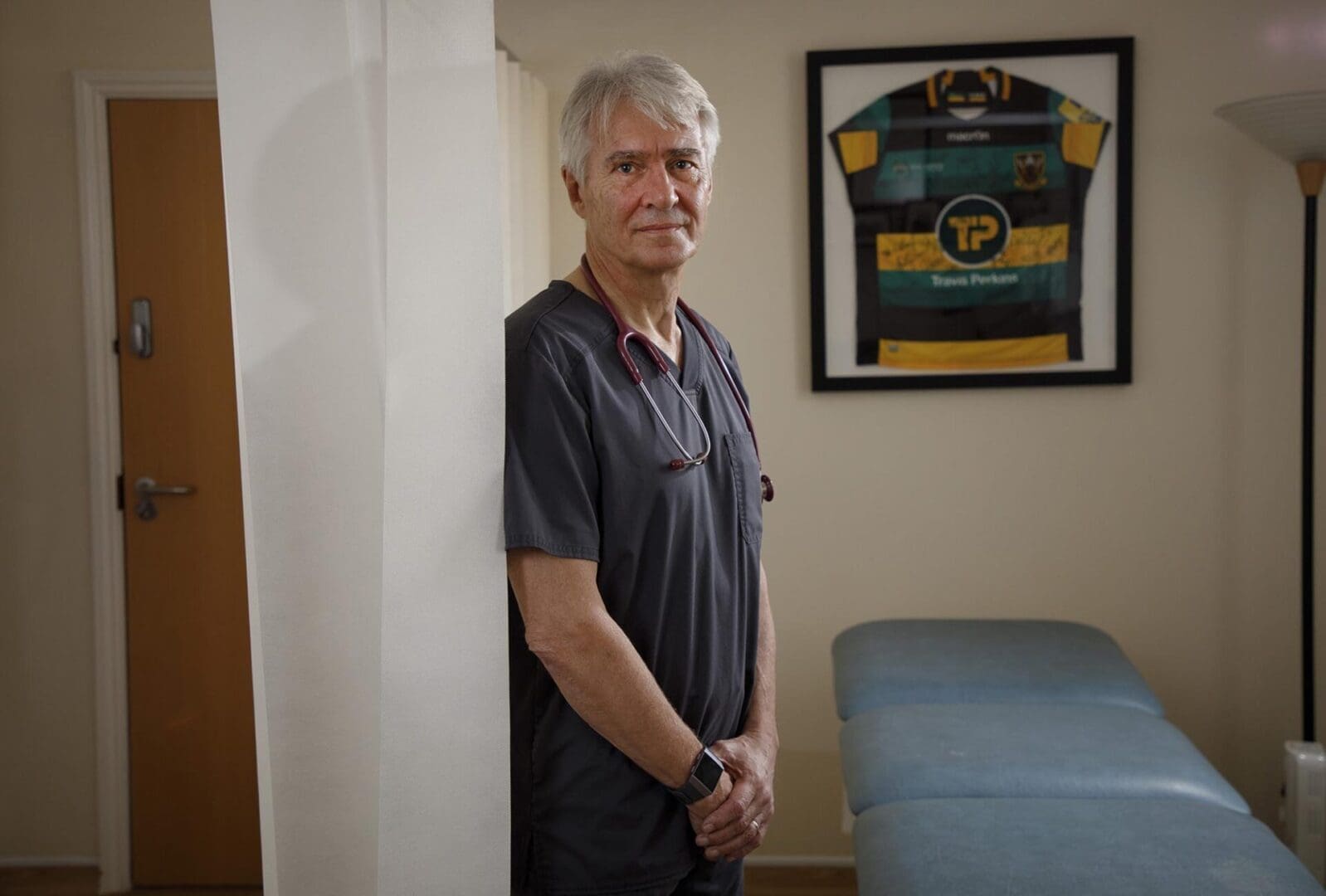
What really happens between the moment an athlete gets injured and the moment they finally return? Consultant Trauma and former Orthopaedic Sports Surgeon Bill Ribbans lifts the lid on the unseen reality of elite sporting comebacks – from high-risk surgeries to Olympic deadlines.
For most fans, a comeback begins with the moment an athlete steps back into play. But long before the crowd sees a return, there is a quieter, more complex process unfolding behind closed doors. One shaped by diagnosis, difficult conversations, risk calculations and the relentless tension between patience and ambition.
For Bill Ribbans, a Consultant Trauma and former Orthopaedic Sports Surgeon, those moments have defined a career spent working at the sharpest edge of elite sport. From shattered limbs and ruptured tendons, to Olympic deadlines and careers hanging in the balance, he has seen firsthand that recovery is never just about repairing tissue. It’s about timing, trust, psychology and the uncomfortable reality that even the most finely tuned athletes cannot escape the reality of biology.
In this conversation, he reflects on what really separates a successful return from a false start, why the mental side of rehabilitation can be as decisive as the operation itself, and the hidden pressures that shape every comeback long before the triumphant return.
Looking beyond the injury
The first consultation when an athlete arrives in Ribbans’ care is rarely just about the injury in front of him. Before treatment plans, timelines or surgery are even discussed, he wants to understand what led the athlete there in the first place. If the problem is a traumatic fracture, the pathway is usually clearer. But with tendon issues, overload injuries or recurring pain, the real story often starts long before the scan.
“You want to know what might’ve led up to it. Had the athlete had previous problems with that area?” he says.
In elite sport, that wider context can be just as important as the diagnosis itself.
For him, the job of bringing an athlete back to where they should be begins long before the athlete ever walks into the room. If someone is making their living from sport, he is not just waiting to assess the injury on the day. He wants to understand the athlete’s level, the demands of their sport and the shape of the season they are trying to navigate.
“I tend to try and do a little bit of homework before they come and see me and find out what their level is, learn a little bit about what their program is likely to be going forward. And then when they come to see me, we clarify all of that.”
The risk before the recovery
Before an athlete can begin the long work of rehabilitation, there is often a far more difficult question to answer: is surgery the right choice at all?
For Ribbans, that decision carries its own kind of pressure – not simply because of the procedure itself, but because of everything that might hang on it. Every operation comes with a degree of risk, however small.
“You’re always aware of that. You’re aware that there is a very, very small risk with any surgery that you do of unintended and unexpected complications,” he says.
Pressure can also come from outside of the operating theatre. When athletes come with a reputation and national attention, it’s hardly a surprise that the stakes extend far beyond the individual on the table. Ribbans recalls operating on Michael Schumacher’s shattered leg and feeling a wide gaze on his work:
“I actually thought as I was operating on him that I was not only doing this for Michael Schumacher, but I was doing it for the whole of British Orthopaedics. We needed to be seen to be getting this one absolutely right.”
And yet, once the operation begins the emotion has to fall away. However high the stakes are, the only way to navigate is technical focus. In that sense, surgery sits at a strange point in the comeback: a moment loaded with pressure, reputation and consequence – but one that can only be navigated by narrowing everything down to the next precise step.
Against the clock
Beyond the body and training plan, there is another pressure shaping every comeback: time.
Unforgiving timelines set by contracts, trials, selection windows and seasons that do not stop for injury. If the injury an athlete has sustained is linked to overload rather than trauma, that can mean tracing back through changes in training patterns or workload. But just as important is what lies ahead.
“If you’ve got, say, an athlete, perhaps it’s a World Championship year or an Olympic year, then not only do you want to confirm when the Olympics are going to be, but then usually they’ve got to qualify through trials. So it’s no good getting somebody ready for a September Olympics if they’ve missed the trials in June or July.
“One of the important things for a professional athlete is their contract. If you take football at the moment, is a player going to be out of contract on June 30th, or have they got two or three years left? Because that makes a big difference.”
Managing
For athletes coming out of a period of injury, they often tend to take more care in understanding how to maintain their level of fitness to avoid any future injury.
Once treatment is given, the priority is making sure the people responsible for the next phase are aligned – physiotherapists, strength and conditioning staff, team doctors, coaches and crucially, the athlete themselves. Recovery, in his view has to be managed through communication:
“It doesn’t matter what level – teamwork is everything. The important thing is to liaise with the people who are going to be responsible for their ongoing care. If you’re looking at a professional team, it’s very important that everybody is in the loop.
“I used to encourage the physiotherapist and team doctors to come into surgery actually, because I thought it was really important that they saw what it was like. It usually means they’re a little bit more careful with their athletes if they’ve actually seen what’s going on inside.”
Though management is not just about the support system around the athlete. It’s about protecting them from the pressure that can build around a comeback. Rather than offering the most optimistic timeline possible, Ribbans tends to be slightly conservative, not to hold athletes back unnecessarily, but to reduce the pressure that comes with trying to hit an exact return date.
“I’ve tended for most people to have a little bit of a conservative approach. That means it reduces the pressure on the athlete and everybody looking after them. And if they’re ahead of schedule then it makes everybody feel better.”
For Ribbans, recovery is not just something an athlete completes. It is something that has to be managed, protected and restrained. The real work after injury is not simply getting back as quickly as possible, but more about building the conditions that make the return sustainable.
More than a return
A return is rarely defined by one operation, one scan, or one triumphant moment returning to the sport.
In this sense, the anatomy of a comeback is not simply physical, it is psychological, logistical and deeply human. It is about understanding that recovery does not happen in a simple fashion, and that the difference between returning to play and truly returning to performance can be far greater than it looks from the outside.
For elite athletes, whose careers are often measured in narrow windows and unforgiving margins, that distinction can define everything.
What Ribbans makes clear is that the best recoveries are not built on urgency, but on realism. Not on forcing the body forward, but on listening to it. Because the true comeback is not the first appearance back in competition. It is the unseen work that makes the moment possible – and the care that ensures it lasts.
Sidebar:
A bend in the road
While an initial injury can feel like the defining blow, sometimes the toughest challenge can arrive later down the line. For Mikey Guinness, a former American Football player at national level, it came six months into recovery, when the return he imagined began to slip away.

“About six months in, my leg was still visibly quite deformed,” Mikey says.
A visit to his GP led to X-rays and the reaction in the room told him almost immediately that something was wrong. “I very distinctly remember the X-ray technicians’ not-so-positive reaction because of how clear the bend was in my leg.”
A referral to a limb reconstruction clinic confirmed it: an infection. The recovery he thought he was on was no longer the one ahead of him.
At first, he tried to laugh it off. But when consultants explained he would need further surgery and that it would involve an external frame, the reality hit: “The next days after that were really hard,” he says. “I hadn’t processed it myself.”
If there is one thing Mikey believes people misunderstand about recovery, it is where the hardest part lies. “Most of it isn’t a physical process, it’s a mental one,” he says. The pain is almost secondary to the isolation. In that kind of recovery, expert guidance matters.
“You’d literally have no idea what you were doing without the consultant to guide you.
They took so much of the weight off.”