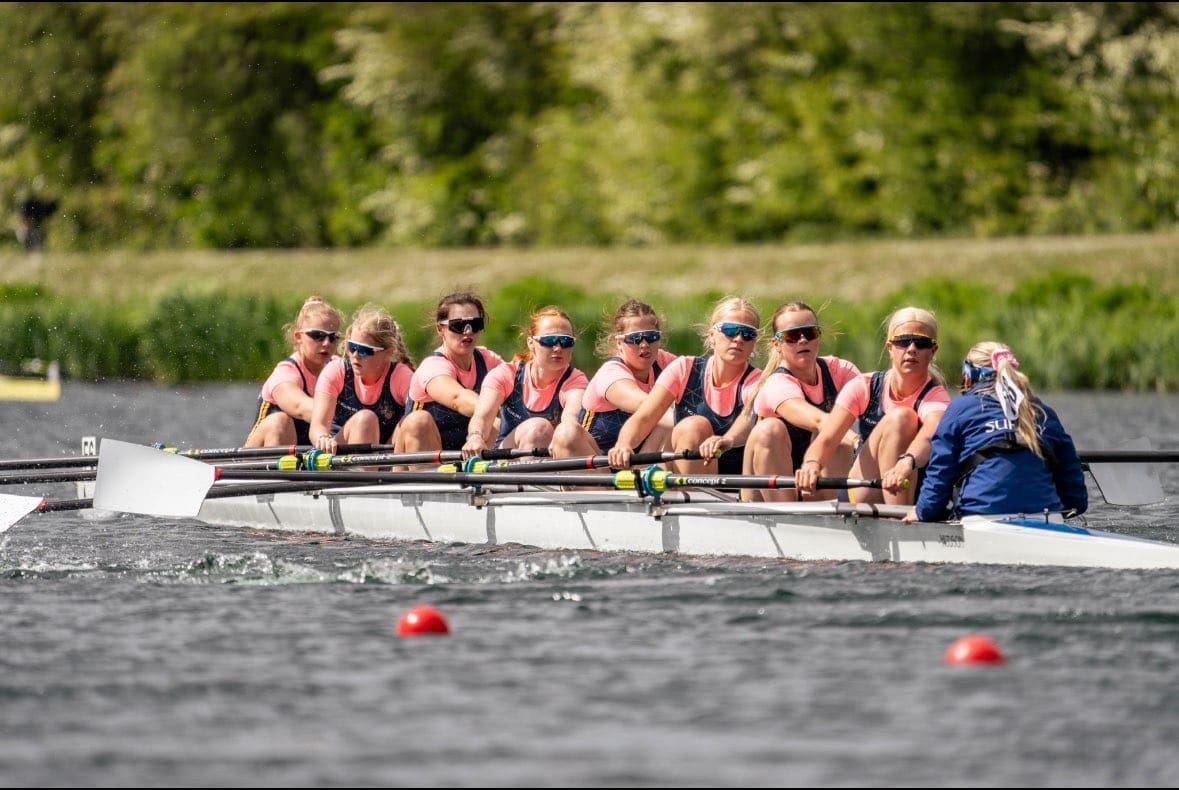
A single mistake cost Surrey’s women’s eight a medal at BUCS Regatta – but their response the next day revealed more about the team than the loss itself.
In the world of university rowing, success is measured in milliseconds and absolute synchronicity. But what happens when that rhythm is shattered by a single mistake? For Izzy Wood, a rower at the University of Surrey, the lesson came during the most prestigious event on the racing calendar: BUCS Regatta.
After eight months of training, Wood’s ‘eight’ boat was sitting comfortably in second place. With 300m left in the 2km race, they were closing in on a medal.
Then, the boat came to a grinding halt.
In rowing, it’s called ‘catching a crab.’ Most commonly, when a rower fails to square their blade correctly, the oar gets trapped by the current and fires back toward the rower’s chest.
“It’s really scary,” says Wood. “The blade comes flying at you, and you’re forced to lie flat until you can dig it back out.”
The mistake came from the boat’s oldest member. The crew plummeted from second to fourth, missing the podium. For Wood, the sting was intensified because the same teammate had made the same error months prior.
How do you handle a team failure caused by one person? For this team their recovery came in the form of silence.
“We just knew not to talk about it,” she says.
“I don’t think I spoke to her for the rest of the day – not because I was annoyed, but because I was so disappointed.”
When a team failure is localised to one individual, the guilt becomes divided. The individual feels they have let everyone down, while teammates grapple with a lack of control.
Wood said the most frustrating part was the recovery time: the team missed four full strokes – a lifetime in a sprint finish.
Moving forward
The true test came the following day, when Wood and three others, including the teammate who made the mistake, competed in a “four” boat. They followed a simple blueprint for recovery: treat it as a brand-new competition.
They prevented yesterday’s baggage from sinking today’s race.
They stopped focusing on the individual mistake and started focusing on the task at hand.
They dominated their time trials and semi-finals, eventually taking second place overall.
While you can’t control a teammate’s error, you can control the collective decision to move forward. The team didn’t let one ‘crab’ define their season; instead, they let their response prove their strength.