Richard Whitehead MBE didn’t just smash his own World Record at the London Marathon 2026, he redefined what is ‘humanly possible’ for blade runners. Now, with his sights set on a staggering 2:35 in Chicago, Richard reveals why the secret to his longevity isn’t just how hard he runs, but how effectively he resets.
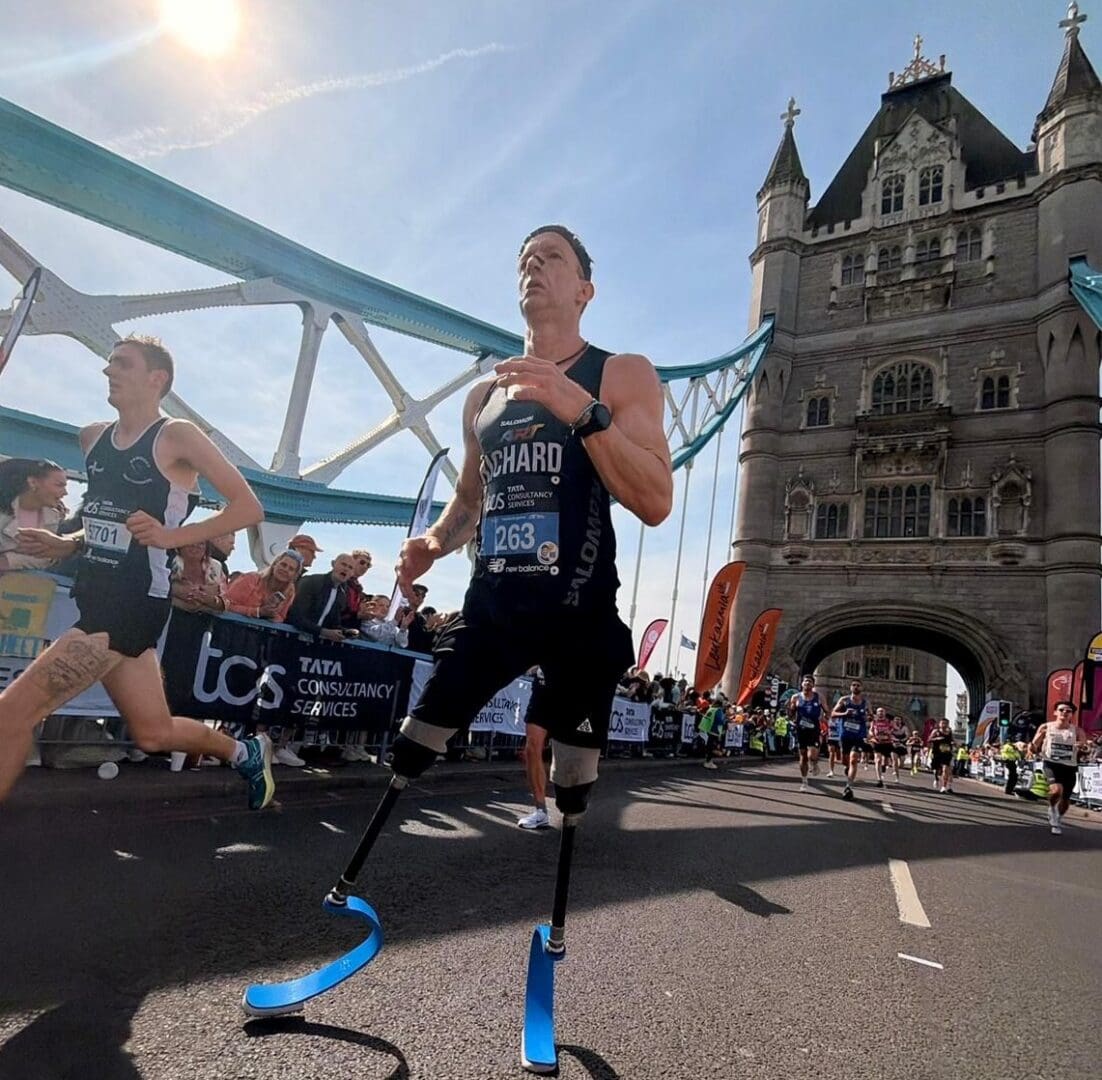
Richard Whitehead MBE crossed the finish line of the London Marathon 2026 in an impressive 2:40:25, beating his own World Record he set just weeks prior in Milan.
Known as ‘Britain’s Bladerunner’, Richard is the fastest marathoner with bilateral knee amputations. Now at the pinnacle of his marathon career aged 49, Richard has set his sights to go even faster this autumn at the Chicago Marathon, aiming to smash the record by a further five minutes.
At the top of his game, Richard knows recovery is everything. Preserving mind and body to perform at its peak, race after race. Richard tells Back in Action about his incredible London Marathon performance and what recovery from world-stage success looks like.
The imperfect record
You’d often expect that preparation must go perfectly before setting a World Record, but that wasn’t the case here. On that warm April morning in London, Richard didn’t feel on top form, let alone expecting the performance he pulled off.
“I got to the startline and I didn’t have a great warm-up,” he says. “I never really put any expectations on myself.”
From before the race even began, Richard had to reset and pivot his usual strategy. He’d arrived at the London startline with incredible momentum from this year alone. “Previously, I’d run in Dubai, Doha, Milan, Boston, and then obviously, London. I broke the World Record two weeks beforehand in Milan,” he says.
“When I run my marathons, I run them in three sections; normally ten miles, ten miles, ten kilometres,” Richard says. “But with this one, I felt I’d just switch it up slightly because my warm-up wasn’t great and I needed to ease into my running.”
But, it was at 16 miles in with crowds roaring and the heat of the late morning increasing, his pacer, Jamie, gave him a time check that would have satisfied most, but for Richard it sparked more.
“He said we were on for around 2:43, which is about two and a half, three minutes slower than my World Record,” Richard says. “I said to him at that point, ‘let’s have a good go and push on’ because we had no expectations at the start. It gave me a real feeling that there’s a possibility of doing something special today.”
What followed was a masterclass in exactly that. “Everything came together in the last ten miles,” he says. “I ran as hard as I could to the finish and literally emptied the tank.”
Crossing the mark in an astounding 2:40:25, Richard set the bar yet again. It was the ultimate validation for the one goal he had in mind: “This year was about running as fast as I can and seeing what is humanly possible for me at my age and with my disability as well.”
The art of the reset
For Richard, recovery is not a passive break between races, it is a high performance discipline. Having completed his 100th marathon last year, he knows the ability to ‘go again’ is rooted in how effectively you can hold back.
“Rest and recovery is key to any kind of exercise and it’s about managing the body’s expectations,” he says.
That experience served as a strong foundation for his current form. “Last year was good preparation for this year in that respect. I’ve done a lot of volume within my racing. To back that up by doing over 70 miles of racing in 15 days, it means that I’m super fit.”
Richard uses a well-trusted toolkit of recovery techniques to ensure this fitness withstands. “I’ve been swimming loads, and also just generally running and jogging at a slower pace,” he says. “But that’s one of the latter recovery strategies because I want to keep off my feet as much as possible.”
“I get treatments as well; soft tissue massages, I utilise a hyperbaric chamber, I do red light therapy.”
However, even for a World Record holder, the initial reset after the London Marathon starts with taking a week off training completely. “A normal rest week would be just hanging out with the family, easing off a little bit on my nutrition, not massively using off, but maybe a couple of cheat days,” Richard says. “And then I do a lot of walking which is great for mental health as well as physical health.”
Beyond the physical rest though, Richard also takes time to reflect on the race. “Just cut out the noise, evaluate what I’ve done previously. Then just kick start and go again.”
“It’s about believing that I’m in a good place and I’ve done enough. I’m not trying to overtrain or do too much,” he says.
Mechanical mishaps
For an able-bodied runner, a ‘mechanical issue’ might mean broken trainers or a GPS watch failure, but for Richard it can be catastrophic. Relying on double blade prosthetics means at times there’s more margin for error.
“Technology can aid success, but also if it does fail it has a massive impact on that success,” he says. “That’s why you need to try, try, try, prepare, prepare, prepare in order to be successful.”
This preparation was put to the ultimate test during his 100 marathons goal. “Last year I had a mechanical issue with one of my prosthetics that nearly stopped me from doing that event, and if I didn’t complete that race, I probably wouldn’t have completed my 100 marathons because it was right towards the end,” Richard says. “I had to solve the problem really quickly.”
“I always take two or three spares for every piece of technology I use, which is not easy when you’re travelling all over the world but it’s a requirement that I need.
“When you do have those setbacks, it’s about having systems in place that enable you to problem solve.” Being a master at his craft, Richard has built a seamless team and process to ensure that prosthetic failure never dictates his goals.
Here comes Chicago: 2:35
If London was about proving what is possible, then the Chicago Marathon 2026 is about redefining it entirely. The recovery period following Richard’s latest World Record is simply a bridge to a much higher goal.
This isn’t his first experience with the Chicago course, but it is certainly his most prepared one. “I’m looking for around 2:35 for my marathon in Chicago, which I tried to do two years ago and I just didn’t get anywhere near it,” he says. “My legs just weren’t able to stand up to the speed that I was running at and my system wasn’t fuelled appropriately.”
“Now I’m working with a sports nutritionist and he’s transforming me into a 30-year-old runner,” Richard jokes.
Shaving five minutes off a fresh World Record is no easy feat, but Richard seems calm and collected for the challenge ahead. “The way to do that is I’d have to have more intent at the start of my race, and then just hold that intent all the way through.”
“I’ll have a lot of support on the course. I’ll have pacers. I have people to be able to push me onto that. Chicago’s a good course and I’ve done some good racing there.”
With a refined nutrition strategy, recovery perfected, and a team on standby to guide him to the finish, October will tell all as Richard faces the prospect of smashing yet another of his own World Records.