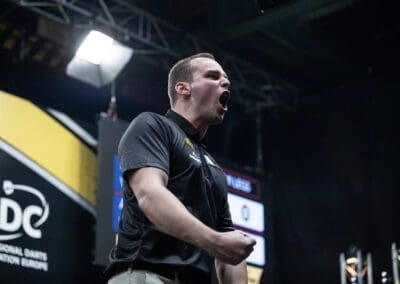
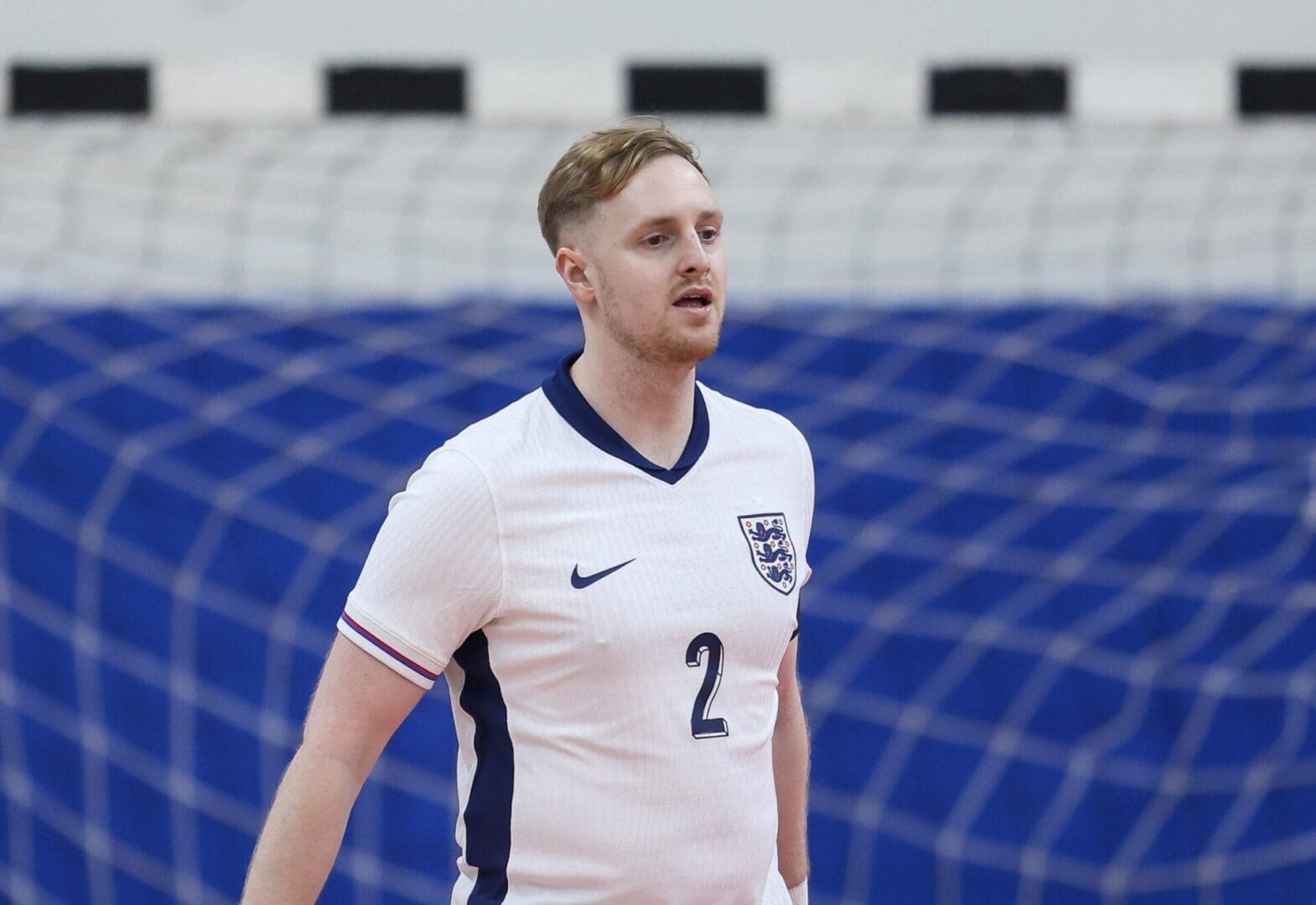
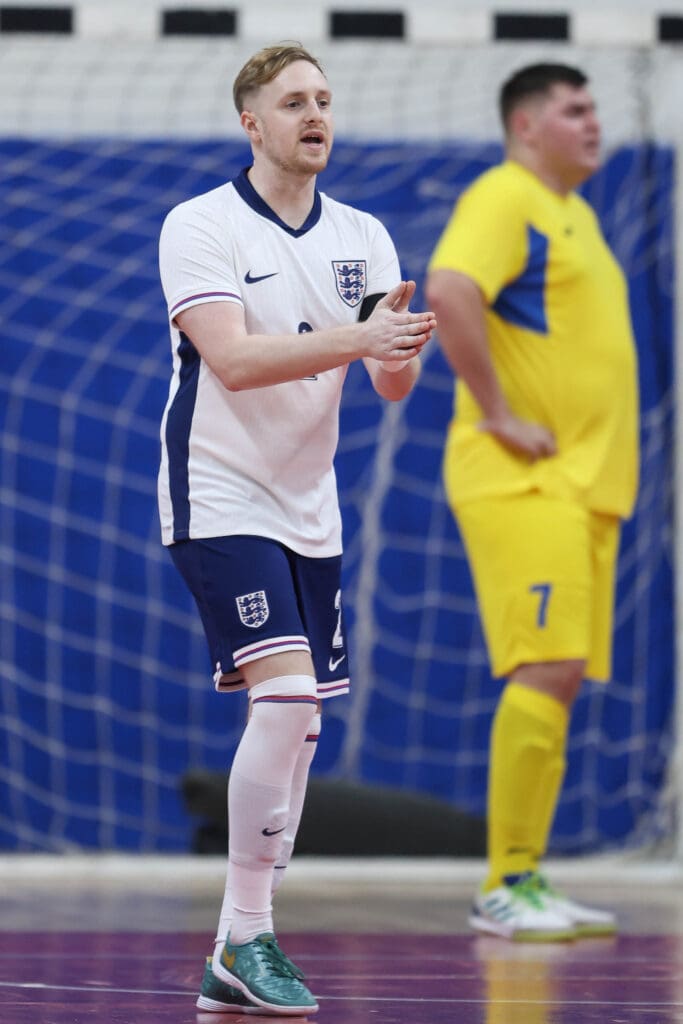
England partially sighted futsal star Paul McHugh won the Golden Boot by the age of 18 and has scored almost as many goals as he has won caps for the nation. But at the peak of his powers, injury struck and added another challenge he had to deal with alongside his visual impairment.
It is November 2025. The England partially sighted futsal squad sit in a meeting room two days before the World Cup final, their annual Secret Santa is about to start, but the mood shifts from focused to hilarious as Paul McHugh is rolled into the room.
Lying on a trolley used to transfer beer kegs, with two foam rollers taped to his chest, the man with over 40 international caps belts out a rendition of Feliz Navidad. The gift exchange lasts around an hour, with McHugh still on the trolley as his teammates pelt him with rubber chickens.
“Bro, why is everyone aiming at me?” McHugh says after four chickens hit him at once.
Behind this joker, however, is a story of resilience. McHugh’s career has been shaped by two forces: world-class talent and the dual challenges of long-term injury and visual impairment.
Living with nystagmus
McHugh has always been a gifted football player, rising through the ranks at Birmingham City and Burton Albion as a youth player.
“Playing sport was what I loved and I felt I could play in a mainstream environment and my impairment would not impact me,” he says. “I’ve got nystagmus which means my eyes are sensitive to light.”
His condition means that his eyes move from side to side, as though he is scanning to make a pass – a skill that has become one of his greatest strengths.
“I think growing up with a visual impairment you have to adapt,” McHugh says. “You learn to do things differently, and also being adaptable makes you more resilient.”
Due to having nystagmus, McHugh is not able to drive or read small writing. “With driving, it’s hardest when you turn 17,” he says. “All your mates start learning and become independent.”
This might not seem obvious to those who see McHugh as an England player. Despite the fact he has won two world silver medals, the challenges he faces surrounding mobility are far greater than most international athletes.
Injury at the top
By 2019, he was playing in the highest regional university division and was one game away from a national title. Then, everything changed.
“I think it was the build up of playing 50 games that season for the uni,” he says. “We were winning 2-1 in the final against Bedford and then out of nowhere, from a movement I had done a million times before, my left knee gave way.”
“You know it’s serious from the popping sound.”
With McHugh’s team then losing 5-4, he not only lost the title, but he lost his momentum. Having won the second top-scorer award two years prior, he was now sidelined and searching for answers.
“It was frustrating at the time because I wasn’t sure what it was,” he says.
“When you are injured, you don’t give up, but you become numb to feeling negative. I didn’t want to feel like I had to rely on people all the time.”
Mountains and misdiagnosis
The road back was riddled with errors. An initial X-ray at A&E – which cannot detect ligament damage – resulted in a six-week recovery estimate. As McHugh speaks about this period, his trademark cheeky smile vanishes, replaced by a serious look of recollection.
Weeks passed and he still couldn’t walk. “In the first month of an anterior cruciate ligament (ACL) injury you can’t get around, but then the swelling reduces and you can walk. I remember hiking up mountains in Australia a little while after I’d ruptured it – but I hadn’t known that I’d done it!”
The grin returns. This epitomises McHugh’s character: a man who would unknowingly climb a mountain on a snapped ligament.
Eventually, a private surgeon confirmed his ACL was ruptured and McHugh underwent surgery a month later.
“This ACL killed me and I still have problems with it even though it was 7 or 8 years ago,” he says. “I wasn’t able to recover properly from it.”
Trying to focus
Even though he might have been able to do bits of rehab without going to a gym, McHugh’s strength was challenged once again due to his visual impairment.
“I don’t think my eyesight caused the injury, but in terms of the rehab, improving my balance and co-ordination was tricky,” he says.
“I remember people telling me to look at one spot when balancing, but with nystagmus I can’t focus.”
“People think you are in your head, but you are only in your head if you know it doesn’t feel good.”
After making it through rehab, McHugh returned to team training and was on track to play in the fast approaching 2023 World Championships.
For a second time
On the eve of their opener against Spain in the World Championships, McHugh recalls being concerned about the surface of the court, having done a practice earlier that day.
“The surface was sticky and I remember saying in the training session I would be in trouble because of being too heavy and the court being sticky, so the combination of the two came together,” he says.
“As my left knee was still weaker, I was over compensating on my right.”
Spain were 3-2 up in the last minutes of the game until…“I scored and tried to miss running into the post, but as I tried to step out of the way, my knee couldn’t turn in time,” McHugh says.
He fell to the floor, and whilst everyone was celebrating his equalizer, his World Championships were over.
“I remember when the physio and doctor came over, I told them I had ruptured my right ACL.”
“The more injuries you get, the better you know yourself, and I knew straight away.”
McHugh knew what was to come. Again, his visual impairment would add another level of challenge to his rehab, such as physically getting places where he could receive support. However, this time McHugh’s road to recovery looked different.
“I had a scan within two weeks and then surgery four weeks later, meaning that I didn’t lose lots of muscle, which was positive.”
Supported by The FA, McHugh attended injury clinics with other disabled England players. “You built that support network with each other to get through,” he says. “It puts you in a positive mindset.”
Momentum gained and lost
Despite the smoother recovery process, McHugh knew there would still be bumps in the road.
“For me, the hardest thing was the impact it had on my life at home, knowing I would be hobbling around for months – it stops you doing stuff.”
McHugh‘s aim was not to win a gold medal, but just be back on the court.
“I wanted momentum. Every time I didn’t have to pull out of a session or game I built momentum,” he says.
McHugh made it through the European Championships in 2024 unscathed and even picked up a bronze medal along the way. But it wasn’t long before he suffered another knee injury in the second group game at the World Cup in 2025.
“I felt numb, but that must be a defence mechanism,” McHugh says. “I was aware of having a negative impact on the team, and that is the worst thing you can do.”
As he speaks, that smile appears again. That is Paul McHugh.